Poco-Poco Dance Has Been Haram in Perak Since 2011
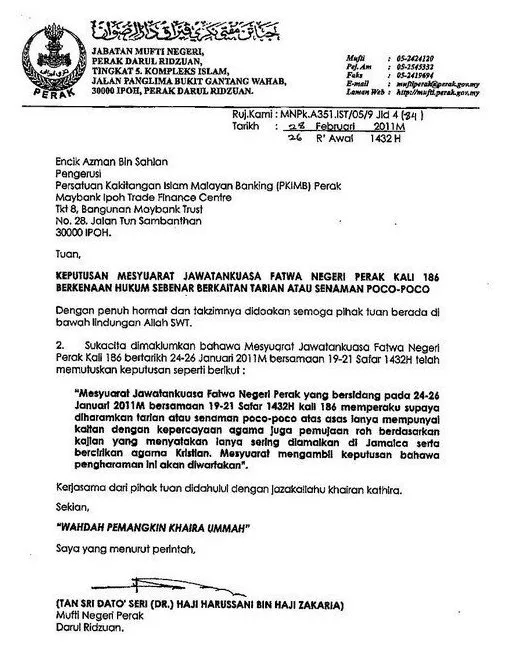
The Perak State Fatwa Committee meeting held from January 24 to 26, 2011, recommended banning the poco-poco dance or exercise on the grounds that it is linked to religious beliefs and spirit worship, based on studies stating it is often practiced in Jamaica and has Christian characteristics. The meeting decided that this ban would be gazetted.
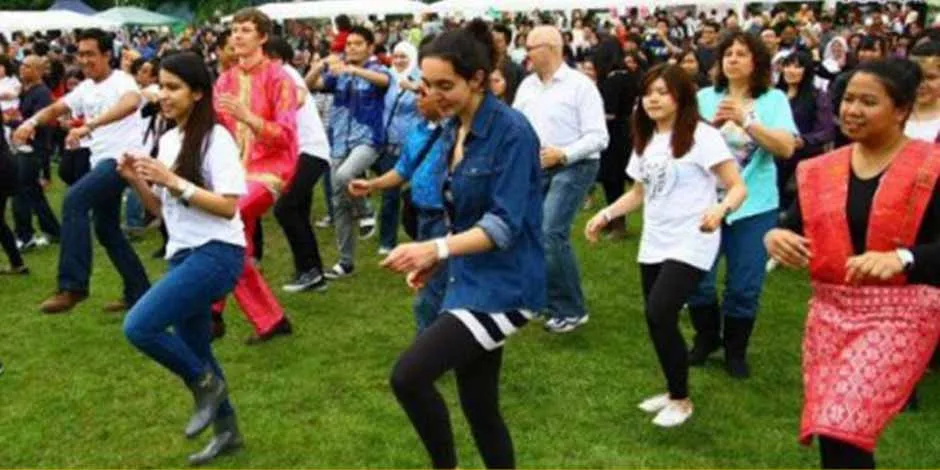
That is an excerpt written in a letter to Mr. Azman Bin Sahlan from the Mufti of Perak, Tan Sri Dato' Seri (DR.) Haji Harussani Bin Haji Zakaria. The unanimous decision was reached at the 186th Perak State Fatwa Committee meeting held from January 24 to 26, 2011. The Poco-poco dance is a type of group dance in the form of aerobics and is popular as a recreational activity in Malaysia. However, this dance sparked controversy when it was declared haram by the Perak State Fatwa Committee in January 2011 because it is linked to religious beliefs and spirit worship, based on studies stating it is often practiced in Jamaica and has Christian characteristics.
The Mufti of Perak, Tan Sri Dato' Seri (DR.) Haji Harussani Bin Haji Zakaria, stated that the dance was banned because it contains elements of another religion, namely Christianity, in addition to spirit worship. News of the ban also received coverage in Indonesia, Qatar, and several other countries. There are two theories regarding the origin of the dance, either from the Philippines or Indonesia. Based on the word "poco" in some dictionaries, it refers to a type of wild dance performed while possessed by "ancestral spirits." This includes the term "Pocomania" according to Encarta and Britannica. The Poco-poco dance has cross-like elements due to the movement steps to the right-left-front-back. The Poco-poco dance also consists of a sequence of movements from right to left and back to front (resembling a cross). Additionally, there is also the mixing of genders in the practice of the dance.
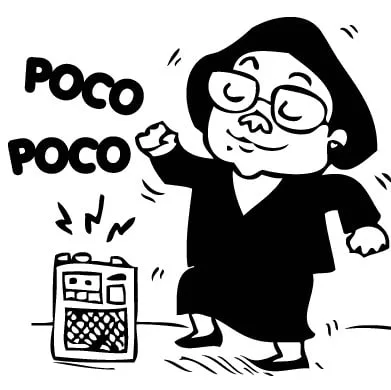
The National Fatwa Council Committee Muzakarah has decided that the Muslim community in Malaysia may continue to practice the poco-poco dance as long as it does not contradict Islamic teachings and the 2007 Guidelines on Esoteric Practices in Traditional Malay Performing Arts. This is based on the principle that any practice can be performed by Muslims as long as it does not contradict the Islamic religion or resemble other religions. The Chairman of the National Fatwa Council, Prof Emeritus Tan Sri Dr. Abdul Shukor Husin, said that Muslims can practice the dance or exercise as long as they comply with guidelines, including dress ethics, no free mixing, mysticism, rituals, esotericism, superstition, and myths that could affect one's faith. However, the committee respects Perak's decision to ban poco-poco in the state in January 2011, which is based on the premise that any involvement in activities that resemble other religions and contradict Islamic teachings is haram.