Perak Man and Perak Woman
Perak Man was a man aged between 40 and 45 years old, 157 cm tall, who lived a healthy life, ate fiber-rich food, and walked with a stoop. He had an atrophied left hand and a deformed finger.
Perak Man is a nearly complete Palaeolithic Stone Age human skeleton ever discovered in Southeast Asia and is a prehistoric bone specimen with a congenital deformity known as Brachymesophalangia. Perak Man was buried in a "foetal" position, with his legs folded towards his chest and his hands holding several types of meat. He was buried alongside several stone tools and thousands of river shells. Judging by his burial position and the items buried with him, it is believed that this Perak Man was an important member of his tribe.
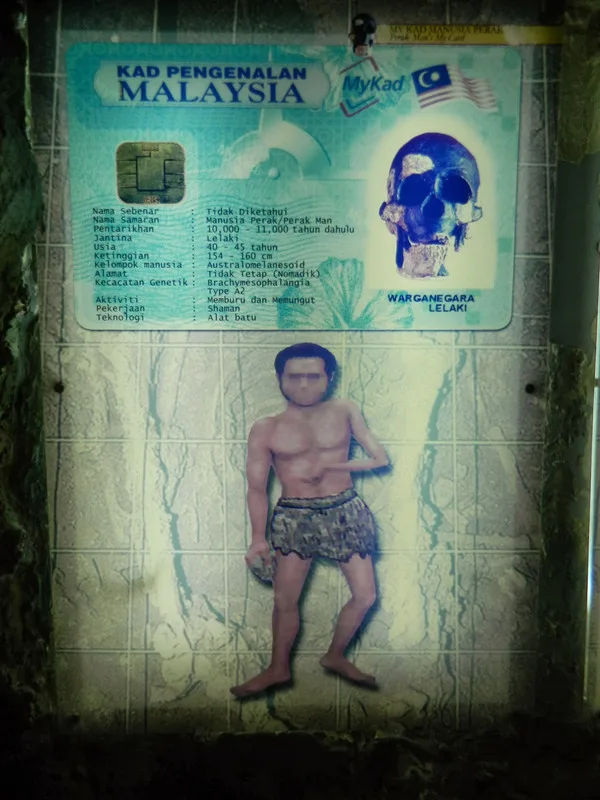
Perak Man, also known as the Perak Person, is the oldest human skeleton ever found in Malaysia.
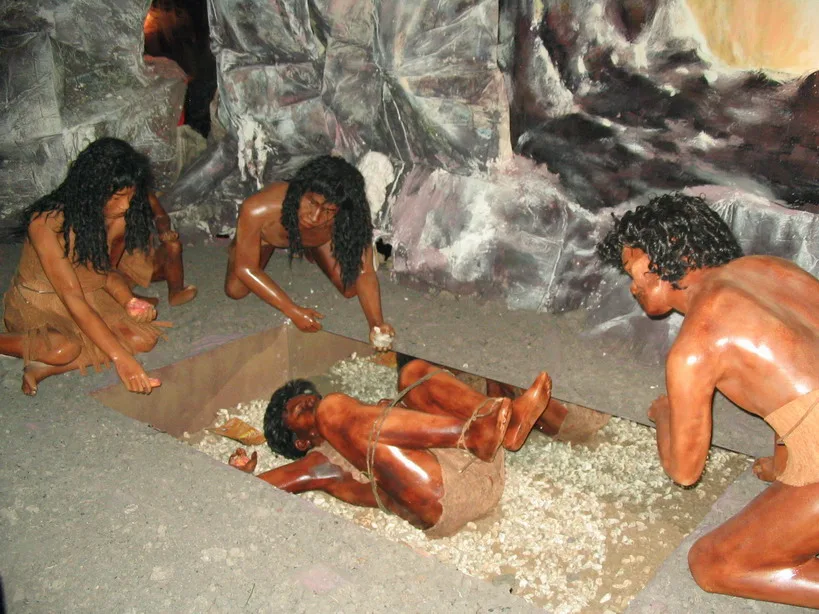
The Perak Man skeleton was discovered in 1991 inside Gua Gunung Runtuh, located at Bukit Kepala Gajah, Lenggong Valley, Hulu Perak, at an altitude of approximately 105 meters above sea level.

This discovery was the result of research conducted by the Malaysian Archaeological Research Centre USM, led by Professor Emeritus Datuk Siti Zuraina Abdul Majid, in collaboration with the Department of Museums Malaysia. Among the most significant findings was the Perak Man skeleton, which is approximately 10,000 to 11,000 years old. Gua Teluk Kelawar is located in the Kepala Gajah limestone hill. This cave formed several shelters inhabited by families as early as 10,000 years ago, as discovered through research conducted by the Malaysian Archaeological Research Centre USM. Thirteen years after the discovery of Perak Man, in 2004, Perak Woman was found. It is a female human skeleton dating back 8,000 years, discovered in Gua Teluk Kelawar in Lenggong. It is believed that Perak Woman was 40 years old at the time of her death and stood about 148 cm tall.