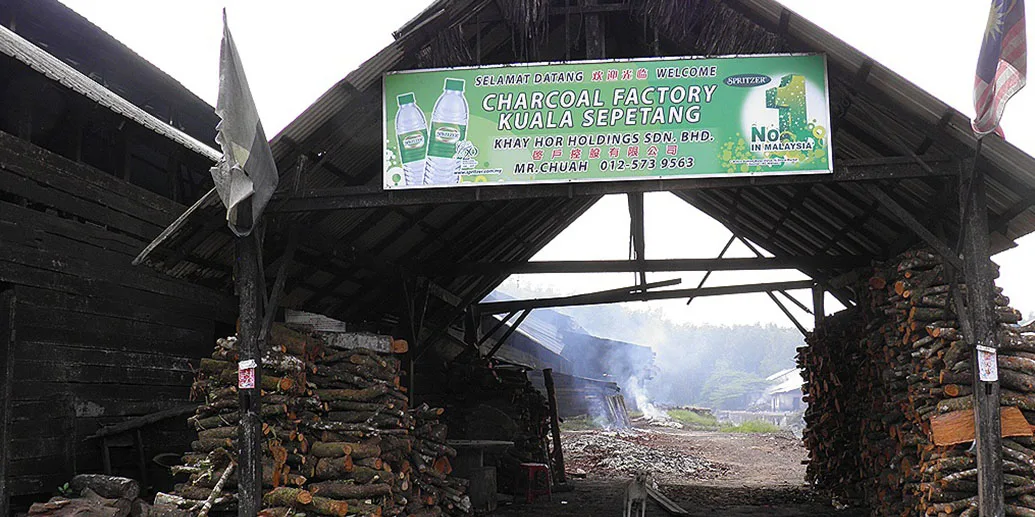
Charcoal Factory, The Oldest Industry in Kuala Sepetang
As the oldest industry in Kuala Sepetang, the production of charcoal from mangrove wood is not only complex but requires unique and challenging skilled labor. The process of burning mangrove wood in kilns or furnaces is divided into three stages and takes about a month. It is not as simple as picking up twigs and burning them into charcoal like we usually do for barbecuing chicken or other foods.
The first and second stages both begin with large and small fires burning for 20 days before the igloo-shaped kiln is completely sealed for another 10 days for the cooling process. Throughout this period, the third stage, which is the cooling process, is the most critical time and must be carefully monitored to ensure the charcoal inside the furnace does not burn into ash.

Cooking charcoal is not an easy job because the burning must be monitored 24 hours a day to ensure there are no leaks in the furnace walls. If an unnoticed leak occurs, the 10 tons of wood inside the furnace could burn into ash, resulting in losses of over RM10,000. In addition to the time-consuming furnace burning, the work of transporting mangrove wood across the sea and rivers from the logging site to the charcoal factory is also one of the most challenging tasks.

Mangrove charcoal produced in Kuala Sepetang is among the best quality in the world and is in high demand in Japan, the Middle East, and Korea. Beyond being used as fuel, charcoal is also utilized in the manufacturing of cosmetics, detergents, fertilizers, mosquito coils, and piling stakes. Demand for charcoal is very high, but production is regulated by the Perak Forestry Department due to limits on mangrove forest logging.