The Fading Tradition of 'Usung Rumah'
Moving is a common part of our daily lives today, often necessitated by work or other factors.
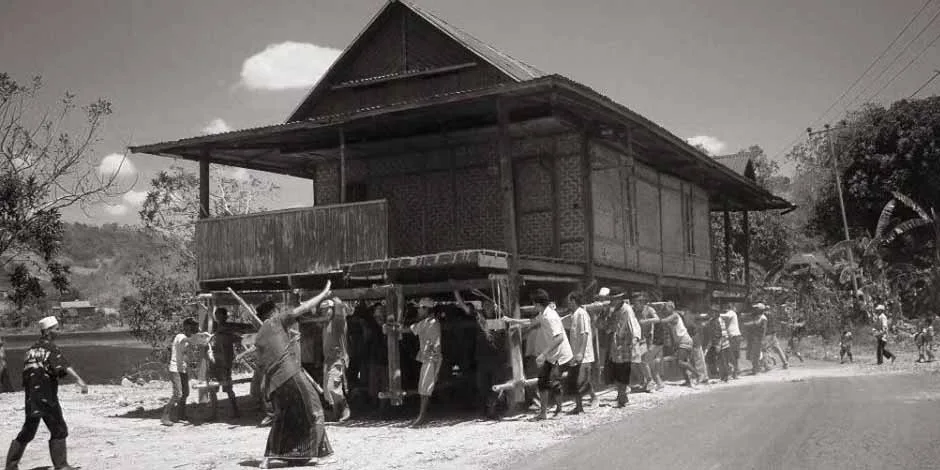
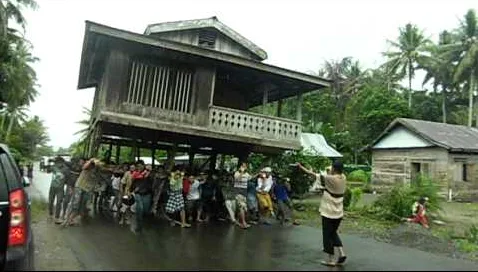
Typically, when moving house, all belongings are transported by renting a truck, regardless of whether the new location is near or far. However, in reality, many today have forgotten or are perhaps completely unaware of the 'usung rumah' (house-carrying) practice used to move from one location to another. This practice was once a cultural staple of the Malay community, not only in our country but across the entire Nusantara region. For those who don't know, 'usung rumah' refers to an activity where people work together to help a homeowner move. They would gather to lift and carry the house to a new location using human strength, especially in villages and over short distances. Since the colonial era, it was common to see the Malay community engaging in this 'gotong-royong' (communal work) tradition almost every weekend. Today, it is rarely seen, having nearly vanished due to the currents of modernization.
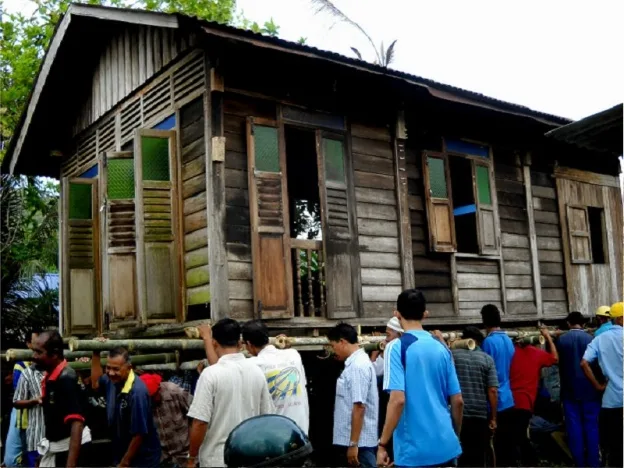
The rise of modern housing and concrete structures in villages has contributed to the decline of this practice, even though the spirit of 'gotong-royong' remains strong. Furthermore, 'usung rumah' only involved wooden houses on stilts and could not be performed for brick or concrete homes.
One of the essential preparations before a house is moved to a new location is the provision of carrying supports, usually made of bamboo. These bamboo supports are used to facilitate the lifting and carrying process.

Initially, the bamboo would be cut down through communal effort and then tied to every corner of the house. The amount of bamboo used depended on the size of the house being moved. The house also had to be emptied of all furniture and items to reduce the weight for those carrying it. Aside from the group of carriers, an important individual in this process is the leader, known as the 'tekong'. The 'tekong' plays a crucial role in directing the movement. They are also responsible for ensuring the house does not hit trees or other obstacles.

The 'tekong' must be attentive to everything and is responsible for informing the carriers of any obstacles ahead, such as bumps, tree stumps, mud pits, or ditches, so that the carriers can be more careful.

After the house-carrying activity concludes, the participants are usually treated to bean porridge or fried vermicelli, along with coffee. A sense of satisfaction is felt by both the carriers and the homeowner after seeing the house arrive perfectly at its new site through the unity of strength, cooperation, and tolerance.

This Nusantara-style house-moving activity is rarely seen today. In Sulawesi, it is called 'mappalette bola', while in Java, it is known as 'boyongan'. In the Malay Peninsula, the names vary. In Perlis, it is called 'alih rumah', in Perak it is known as 'pindah rumah', and in Kelantan, it is called 'usung rumah'.

Whatever the name given to the activity, it should be remembered by our society today because carrying out such a task requires a very high level of spirit, cooperation, and unity.