The Book of Elephant Care in Hulu Perak
The northern part of Perak has a hilly and densely forested geography. Loyal readers of orangperak.com can see this in the Gerik, Kroh, Pengkalan Hulu, and Kelian Intan areas.
The northernmost district in Perak has long attracted animal hunters because it is said to be home to various exotic animals in the Belum Forest. Since ancient times, Hulu Perak has been a draw for animal hunters, especially for elephants; the Sultans who ruled Perak were no exception, for instance, Sultan Iskandar Zulkarnain (1756-1770). He was very skilled and was said to enjoy 'playing' with elephants. At that time, Hulu Perak was very famous for its large elephant population, due to the forests that blanketed the region's geography. The Misa Melayu mentions that Sultan Iskandar Zulkarnain traveled to Pachat (an old district in Hulu Perak, once governed by Tok Temong). It is said that at Pulau Pachat, elephant performances were held simply for the entertainment of the royalty. Owning elephants and giving them 'pet names' was a must for the Sultans and rulers. For example
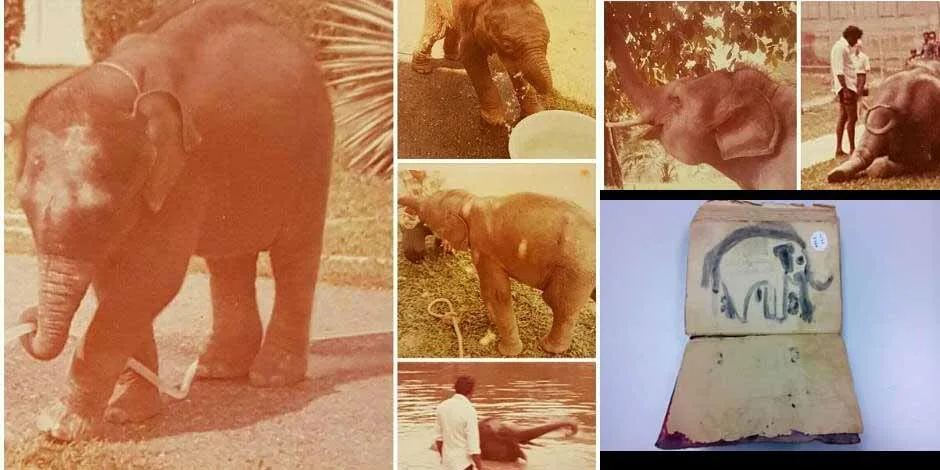
Sultan Idris Shah II
(1963-1984) who owned elephants named 'Mek Cik' and '
Awang Majlis
'. This defines that the rulers, especially the kings, had a close relationship with elephants.
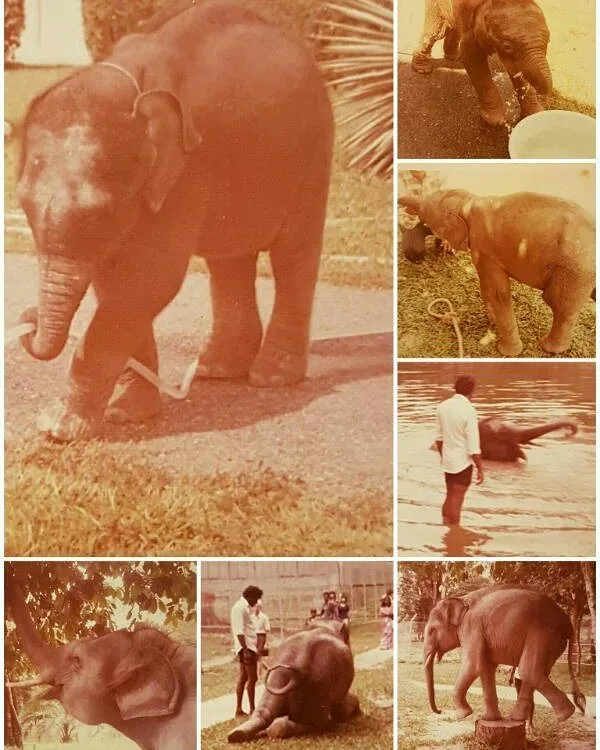
An elephant named 'Awang Majlis' which belonged to Sultan Idris Shah II. [Source: Instagram page of Raja Nazhatul Shima Idris/Daughter of Sultan Idris Shah II]
It is not an easy matter to handle an elephant, which is known as an animal with the strength to topple large trees and crush cars. Therefore, Sultans who owned elephants would also have a tamer/keeper, or what Abdullah Munsyi referred to as a 'pawang gajah' (elephant shaman). The definition of a pawang gajah, according to the author, is an individual capable of curing elephant ailments (usually using supernatural powers). Abdullah Munsyi mentioned
'So, after a few days in Melaka, his name became famous as a Pawang Gajah who knew of medicines. His daily routine was to roam the deep jungles' - (Zahari A. Rashid, Kenang-Kenangan Abdullah Munsyi, 2008)
A pawang gajah is someone knowledgeable about everything concerning elephants, including handling, taming, curing illnesses, and warding off jungle spirits (during the elephant capture process).
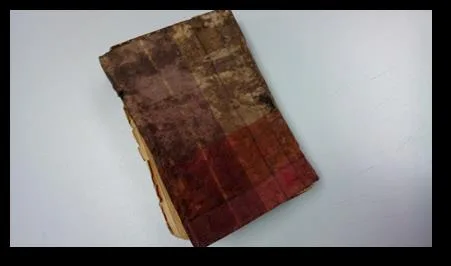
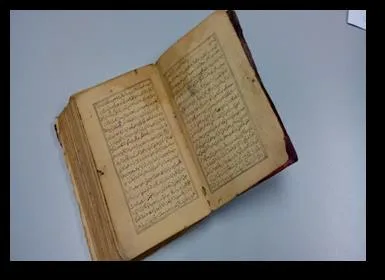
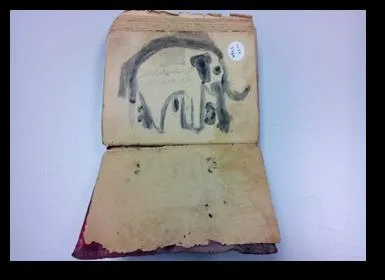
[Front Cover of the Mantra Gajah Manuscript (Book of Medicine, Tips, Spells, Amulets, and Incantations for elephants), from the author's personal collection obtained from the Malay Manuscript Centre, National Library of Malaysia.]
Knowledge regarding elephants and how the pawang gajah handles them has been immortalized in a manuscript titled Mantra Gajah. The purpose of highlighting this article is to introduce this manuscript to the loyal readers of orangperak.com, as it is the only manuscript that focuses on how to handle animals (elephants). The manuscript existed in Hulu Perak and is said to have been owned by the Dato Seri Andika Raja of Hulu Perak, known as Orang Kaya-kaya Seri Andika Raja. Mantra Gajah can be classified as a 'medical book' for handling elephants. The author can summarize the contents of Mantra Gajah into 4 parts.
- Spells and incantations used to soften an elephant's heart and tame wild elephants.
- Various herbal medicines shared and used by the pawang gajah to treat elephant illnesses.
- Tips for keeping elephants healthy, brave, plump, and having beautiful tusks.
- Knowledge and tips for warding off jungle spirits in the forest (during the elephant capture process).
This book of mantras simplified the way of handling elephants and was very practical for use in ancient times. Some of us might question the relevance of this book, but in the old days, especially for a pawang gajah who truly mastered the knowledge of Mantra Gajah, they could attest to its truth. Besides being used for 'playing' or performances for the Sultans, elephants were also used as transportation. Many ancient records mention the use of elephants in daily life, not only involving the Sultan but sometimes commoners also used and owned them. Isabella Bird (an ancient traveler) who once arrived in Perak was greeted by an elephant belonging to Sultan Abdullah as her mount. For elephant owners, the health of the elephant was very important, especially for daily activities and as an official mount for Sultans and dignitaries. As mentioned by J.M. Gullick, in northern Perak, there was a person known as Syed Zain who owned an elephant. Elephant health was crucial, including their tusks, which were said to play a major role in medical aspects. The language used in the mantra book received Hindu-Buddhist influence and was crafted using a mixture of Malay and Sanskrit. Perhaps this mixture was an influence from Siamese culture, which was received by the Hulu Perak community due to their proximity to Siam. In matters such as elephant knowledge, only Perak could compete with Siam. Siam was said to frequently request unique elephants from the forests of Perak. The existence of the Mantra Gajah book proves the 'local genius' in handling and managing elephants. It is proven that this wisdom is not just to be remembered but to be practiced as a treasure of knowledge for the current generation to behold.
An Elephant is a Large Beast Living in the Bushy Forest Walking and Stopping with Ears Flapping Mosquitoes and Flies are Very Troublesome
When Tame, It Can Be Ridden, Heavy Loads Can Be Carried, No Matter How Much, It Is Not Felt Long Journeys Can Be Traversed
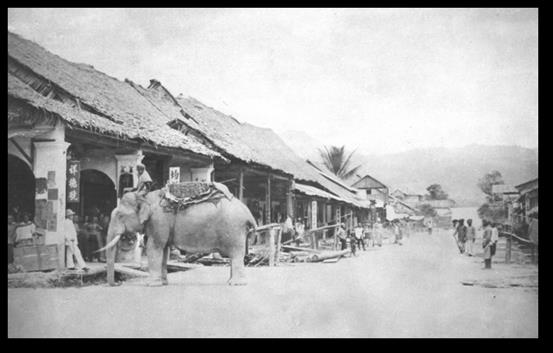
[An elephant in the old town of Taiping, known as Kelian Pauh at that time, Source: Author's personal collection, obtained through the Malayan Information Agency, London, in the custody of the National Archives of Malaysia)]
References:
- Raja Chulan. Misa Melayu. 1991. Pustaka Antara
- Jelani Harun. Umpama Sebuah Bahtera, Kajian Naskhah Melayu Sejarah Kesultanan Negeri Perak. 2011. National Archives of Malaysia.
- Azharuddin Mohd Dali. 2014. ‘Gajah dalam Masyarakat Melayu: Penelitian Berdasarkan Mantra Gajah’. Working Paper for the Monthly Malay Manuscript Seminar Series.
- Nurul Izzati Md. Mustafa. 2017. ‘Naskhah Mantra Gajah Sebagai Lambang Sejarah Sosio-Budaya Masyarakat Melayu’. First International Conference on Malay Historiography (HISTIC2017). May 2017. Kuantan, Pahang.