Details of the Court Proceedings for the Birch Murder Case Against Seputum in March 1876
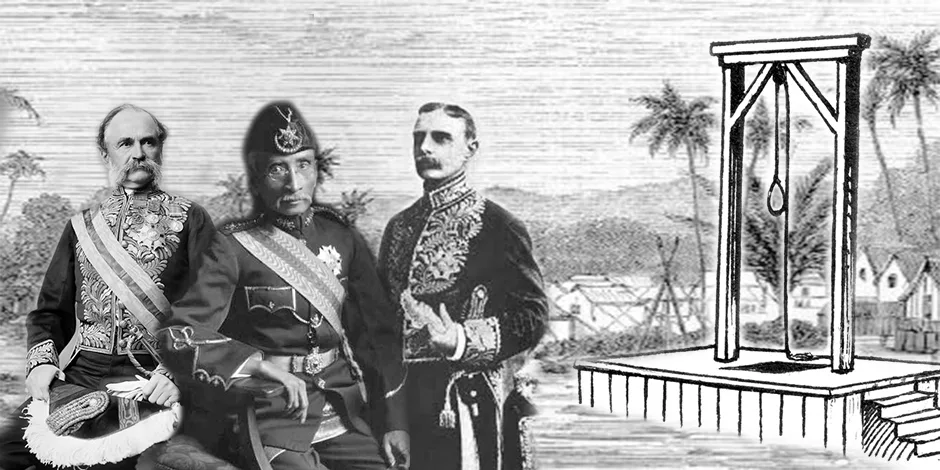
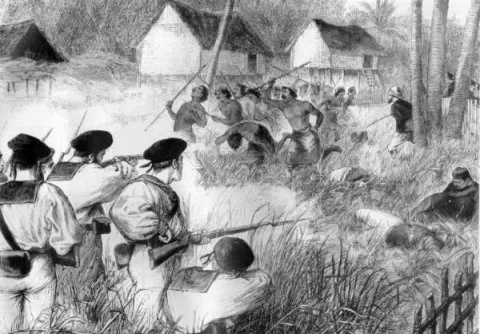
After the battle between British forces and Malay fighters ended in Enggor, the Malay warriors began to retreat to save themselves. At this time, the British forces began to focus their efforts on hunting down those involved in the murder of J.W.W. Birch. This British effort was also joined by Malays, Bugis, Rawa, and Mandailing people, especially those from outside the state of Perak. As a result, Seputum was successfully captured by Mahmin, Odah Pulau, Alang Rupah, Odah Mat Kasim, and Si Kumbang in Lambor. Seputum, Si Gondah, and Ngah Ahmad were imprisoned and later brought to court in March 1876 to face charges of direct involvement in the murder of the British Resident of Perak. They were tried in the Malay court of the Perak state government. Consequently, Raja Idris was appointed by Sultan Abdullah as the judge to preside over this case. Meanwhile, Governor Sir William Jervois appointed J.G. Davidson, the British Resident of Selangor, as a trial assessor, assisted by F. Swettenham.
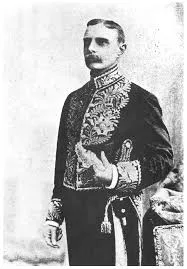
This selection and appointment were based on their extensive experience. J.G. Davidson had experience in the field of law and was serving as the first British Resident of Selangor at the time. F. Swettenham was experienced in administration in the Malay States and was also the acting British Resident of Perak. On March 3, 1876, the court in Bandar Baru began its session. Raja Idris served as the judge, with Davidson and Swettenham as assessors. The accused, consisting of Seputum, Si Gondah, and Ngah Ahmad, were brought to court on charges of murdering J.W.W. Birch, the interpreter Mat Arshad, the boatman Din, and Hend Sheer Singh, one of the resident's officers, in Pasir Salak on November 2, 1875.

The charges were read in detail to the accused, and when the judge asked for their plea, they pleaded not guilty to every charge. After hearing the pleas, the court began the trial by calling Hamid as a witness to provide testimony. Hamid recounted that J.W.W. Birch arrived with his entourage and stayed overnight in Pasir Salak. On the morning of November 2, 1875, at 6 a.m., Lieutenant Abbott and a troop of sepoys went hunting in Kampung Gajah, while the interpreter Mat Arshad went to post a proclamation notice at a Chinese goldsmith's shop. He then explained that Mat Arshad was subsequently stabbed during an altercation. Hamid stated that Seputum was present at that time and shouted in a frenzy (amuk). He recognized Seputum because Seputum suffered from a strange skin disease and elephantiasis on one of his legs. Hamid also stated that Si Gondah was in Pasir Salak on November 2, 1875, carrying a spear and shouting in a frenzy. Meanwhile, Hamid could not confirm whether Ngah Ahmad was present when J.W.W. Birch was murdered. Subsequently, Koh Ah Yong, the goldsmith, was called to testify. He stated that on the day the proclamation was posted by the interpreter Mat Arshad, several people gathered in Pasir Salak, including Ngah Ahmad, who tore up the proclamation and handed it to Dato Maharaja Lela.
Meanwhile, Seputum carried two spears during the gathering. Koh Ah Yong stated that Seputum struck J.W.W. Birch on the head with a long machete three times. Furthermore, he stated that he did not see Si Gondah, but instead saw Ngah Ahmad carrying two spears and a kris. After hearing this explanation, the trial was adjourned for the day. On March 4, 1876, the court reconvened. Koh Ah Yong was called again to testify. This time, he explained that J.W.W. Birch's body was found by the Bugis people, and he concluded his testimony. Next, the court called Hoo Ah Choey to testify. Hoo Ah Choey, in his testimony to the court, stated that Seputum, Si Gondah, and Ngah Ahmad were on the riverbank on November 2, 1875. Seputum tore up the proclamation and struck J.W.W. Birch twice while he was in the water. Meanwhile, Si Gondah and Ngah Ahmad shouted in a frenzy. Both were carrying a kris and a spear. Following this testimony, J.J. Keyt, the resident's clerk, was called by the court to testify. J.J. Keyt stated to the court that after being ordered by the Deputy Commissioner (W.E. Maxwell), he had recorded the confessions of Seputum, Si Gondah, and Ngah Ahmad while they were in prison.

These three statements were read in court. Seputum, Si Gondah, and Ngah Ahmad finally confirmed their respective confessions to J.J. Keyt. These confessions touched upon the events that occurred in Pasir Salak. Then, Hajjah Fatimah was called to testify. She stated that on the night after J.W.W. Birch was murdered, a group of armed men came to her house. Among them was Si Gondah, and they were planning to attack Bandar Baru. Similarly, Haji Mohamed Amin also stated that Si Gondah was in the group that intended to attack Bandar Baru. Additionally, Haji Mohamed stated that Si Gondah had mentioned the word 'Amuk'. Meanwhile, Inspector Lagis bin Suboh, while testifying in court, provided details about the wounds and injuries found on the bodies of J.W.W. Birch and Mat Arshad. After Inspector Lagis gave his testimony, the prosecution against the accused was closed. The accused informed the court that they had no witnesses to provide testimony. Nevertheless, the judge gave the accused an opportunity to provide their own statements. In his testimony, Seputum said that whether he was involved or not, it was all the same to him.

This was because if he had not been involved in the murder of J.W.W. Birch, Dato Maharaja Lela threatened to burn his house and seize his property. Because he was a laborer under the administration of Dato Maharaja Lela, if he did not carry out the assigned tasks, Dato Maharaja Lela would kill him. In the meantime, Seputum also stated that if he committed a crime, it was in the course of carrying out the duties ordered by Dato Maharaja Lela. Similarly, Si Gondah stated that he was ordered by Dato Maharaja Lela. If he disobeyed, his house would be burned and his wife and children would be taken. Meanwhile, Ngah Ahmad stated that he was not present when J.W.W. Birch was murdered. He arrived at the riverbank after the murder had already taken place. After hearing the testimonies of Seputum, Si Gondah, and Ngah Ahmad, the court adjourned its session, which had begun at 8 a.m. on March 4, 1876. On March 5, 1876, the court reconvened.

In summarizing the trial proceedings, Judge Raja Idris informed Seputum, Si Gondah, and Ngah Ahmad that he had heard all the testimonies throughout the court session. He then announced the verdict that all the accused were found guilty, and the court decided that each of the accused would be sentenced to death by hanging. Nevertheless, Judge Raja Idris stated that the hanging sentence would only be carried out after being confirmed by the Sultan. This court decision was sent to the Governor and discussed in the Executive Council chaired by the Governor of the Straits Settlements. The Executive Council was satisfied with the evidence of the charges against Seputum and the death sentence imposed on him. However, the Executive Council was of the opinion that although Si Gondah and Ngah Ahmad were present when J.W.W. Birch was murdered, there was no strong evidence stating that they were involved in the conspiracy to murder J.W.W. Birch.

Consequently, the Executive Council had to intervene in the Malay Court's decision through the Governor. The Governor ordered the Deputy Commissioner of Perak to advise Sultan Abdullah to commute the sentences of Si Gondah and Ngah Ahmad to life imprisonment. Seputum was hanged to death in Bandar Baru on May 20, 1876. His remains were then taken to Pasir Salak and buried there. References:
- Pasir Salak: The Center of the Anti-British Movement in Perak by Associate Professor Dr. Abdullah Zakaria Ghazali