Tracing Conflicting Sources Regarding the Passing of Sultan Ismail, Sultan of Perak in 1889
Tracing Conflicting Sources Regarding the Passing of Sultan Ismail, Sultan of Perak in 1889
For a long time, in modern Perak historical writing, the date and place of the passing of the 25th Sultan of Perak, Sultan Ismail Mu’abbhiddin Riayat Shah ibni Sayyid Sheikh al-Khairat, the Sultan who once ruled Perak for a short period before being ousted as a result of the Pangkor Treaty of 1874, is often cited as having occurred on September 4, 1889, in Skudai, Johor Bahru.
This record appears repeatedly in Malay-language historical works, official websites, and is even accepted as a fact that seems beyond question. This narrative has been inherited by many generations, appearing to be an absolute truth. However, history is not a frozen text; it is always open to reinterpretation when new sources are discovered.
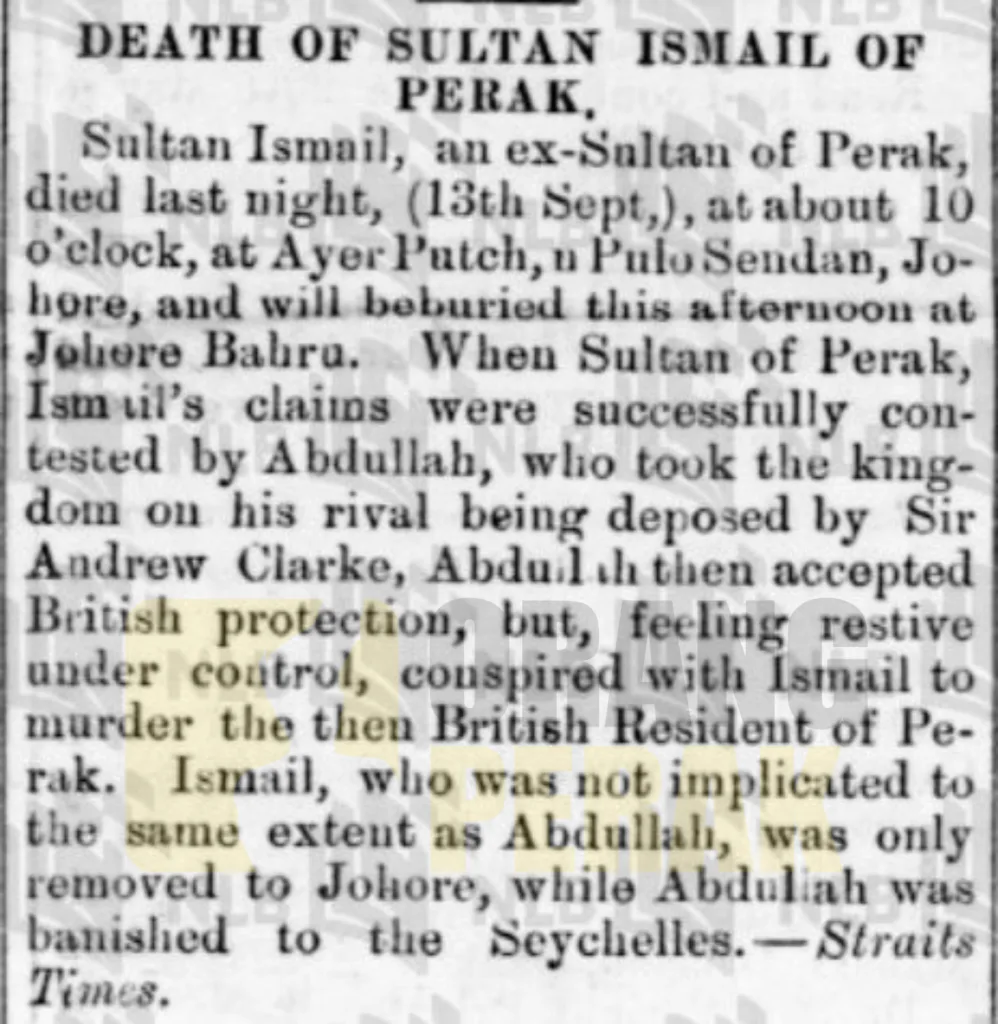
As a result of reader comments and research conducted by Orang Perak, the discovery of an English-language newspaper report dated September 21, 1889, namely The Straits Independent and Penang Chronicle, brings a new dimension that challenges long-held beliefs.
According to the newspaper, Sultan Ismail, referred to as the “ex-Sultan of Perak,” passed away on the night of September 13, 1889, at approximately ten o'clock, in Ayer Puteh, Pulau Sendan, Johor, and was buried the following day in Johor Bahru. This record clearly contradicts what is often presented, which cites September 4, 1889, in Skudai.
This difference of nearly ten days raises major questions about the validity of the information, and forces us to re-examine where the September 4 date originated, how it began to spread, and why it was accepted without much scrutiny.
The conflict between these two sources opens up space for questions regarding historical methodology. To what extent can English newspaper reports be considered authentic? Is the oral tradition or local record that mentions September 4 merely the result of confusion or a recording error?
Or could there be other factors, such as delays in news delivery, misunderstandings between local calendars and the Gregorian date, or negligence in the colonial documentation process? What is clear is that the newspaper report not only records the date and place of death but also links Sultan Ismail back to the early history of British intervention in Perak.
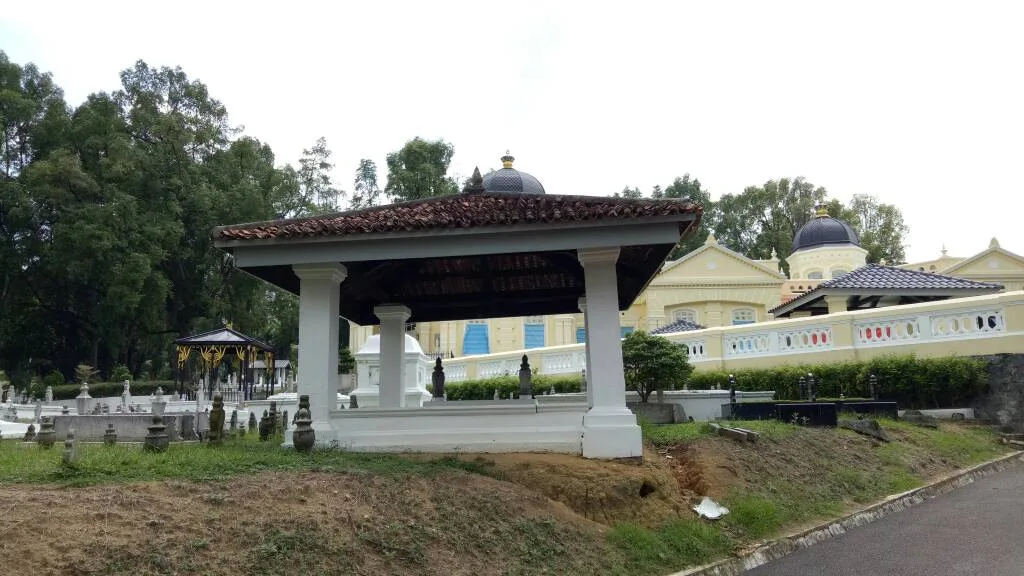
The newspaper reminded readers that Ismail was ousted by Raja Abdullah due to the role of Sir Andrew Clarke, and was subsequently linked to the conspiracy to assassinate the British Resident, J.W.W. Birch. According to the report, Sultan Ismail's involvement was not considered as heavy as Abdullah's; therefore, Abdullah was exiled to the Seychelles, while Ismail was only exiled to Johor, where he lived in isolation until the end of his life.
This context is important because it shows how the colonial authorities interpreted Sultan Ismail's role not as a primary traitor, but as a figure with the potential to cause trouble, and thus needed to be sidelined from the Perak political arena. His life in Johor was no longer widely recorded, making him appear as a “king in exile” who vanished from public memory.
Therefore, when his passing occurred, it is natural that confusion over the date arose because his figure was no longer a focus of major politics. The difference between September 4 and September 13, with a gap of only nine days, may seem small, but in the field of history, it reflects a deeper problem – the question of how we form historical truth, and which sources are more worthy of being used as primary references.
In historiographical discourse, this case emphasizes the importance of source criticism. It is not enough to simply repeat old records; historians must question where the source came from, under what circumstances it was written, who the author was, and what biases or weaknesses are contained within it.
Colonial newspaper reports may have their own agendas, just as local records might be tied to oral traditions or the political influence of the palace. Only by combining different sources—national and Johor state archives, royal family records, burial records, and newspaper reports—can we approach a more balanced picture.
The debate about the actual date of Sultan Ismail's passing ultimately goes beyond mere chronology. It shows how history is shaped by layers of information that overlap, contradict, and are sometimes incomplete. For a historian, this conflict is not a debilitating problem, but an opportunity to open a new discourse.
With the existence of the English newspaper source documenting the date of September 13, 1889, we now have a basis to re-evaluate the old tradition that mentions September 4. That difference should be a field for further research, rather than being left as an unquestioned confusion.
The Perak Sultanate in the 19th century was an institution plagued by power struggles, colonial intervention, and internal turmoil. Sultan Ismail became a symbol of a difficult transition: from a sovereign sultanate to a state that began to bow to British influence.
Thus, understanding the moment of his passing is not just about adding to a chronological record, but also closing an important chapter in the political history of Perak. Whether it was September 4 or September 13, 1889, what is certain is that the passing of Sultan Ismail marked the end of the life of a king who was rejected from his throne, but remained a key witness to the major changes in the history of the Malay Peninsula.
Source: The Straits Independent and Penang Chronicle, September 21, 1889