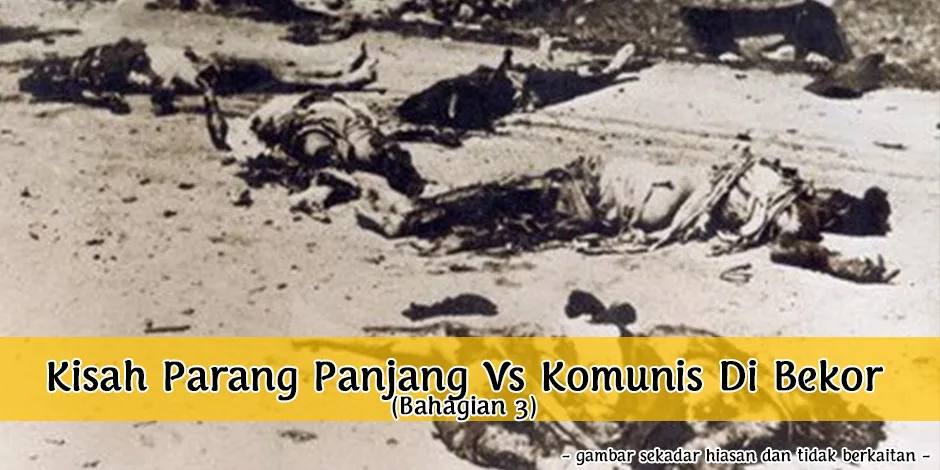
The Story of the Long Machete vs. Communists in Bekor (Part 3)
Uda Mashor's house served as a gathering point for 200 women and children when the attack occurred in Kampung Kelang. The long machete group that defended against the attack in Kampung Kelang consisted of Harun bin Uda Hassan, Hashim bin Mohd Yusuf, and Din bin Ngah Abdul Rauf. This group faced an attack by 20 to 30 communists armed with spears.
Harun bin Uda Hassan and Din bin Ngah Abdul Rauf were stabbed. They fled and jumped into the river, while Hashim bin Mohd Yusuf shifted to defend the attack at Uda Mashhor's house. A drum signal was sounded as a warning and to create confusion. In Kampung Kubang Udang, before the houses were burned, women and children were ordered to come down before fleeing. Men were also killed and burned along with their houses. In Kampung Bekor, all household members were burned alive regardless of gender. Attempts to get help failed as the communists burned houses suspected of being occupied. Syafie bin Nordin saw for himself how his wife died in the fire. He had fled to seek help from villagers while his house was being burned. His wife, Fatimah, and their child, Abdul Rahim bin Shafie, were sheltering inside the house. The spreading flames caused the Chinese attackers to descend from the house. Fatimah was behind the raging fire while clutching her child. Her child was successfully saved by villagers, while Fatimah died in the fire. This attack was reported by the Majlis newspaper on March 5, 1947: "...Malay bodies were found scattered the next day and 19 houses, including a religious school, were reduced to ashes..." Meanwhile, the Majlis newspaper dated February 24, 1947, reported: "...When the witness returned home, he found his house already on fire, but he could not identify who was accused of burning it..." The highest number of houses burned was in Kampung Kubang Udang due to its remote location. In Kampung Bekor, only three houses were burned: the house of Ngah Abdul Rauf, a religious school, and the house of the Kampung Bekor Village Head, Tuan Haji Mohd Ali. However, the villagers involved stated that 40 houses were burned by the communists. Several houses were not completely consumed by the flames because villagers managed to extinguish the fire after the communists left the area. The communist attack was motivated by revenge against the Malays, who were accused of helping the Japanese. The plot to attack the Malays was carefully planned by the communists. The Malays were accused of being turncoats for not supporting the struggle to form a communist republic in Malaya. The first action taken by the Bintang Tiga after the Japanese military withdrawal was to take control of police stations and hunt for ulama, religious leaders, and Malay leaders. In this regard, local leaders who did not cooperate with the communist struggle became targets. Similarly, the attack in Bekor on March 6, 1946, caused the number of Malays in Kampung Bekor to dwindle. The Malay-Chinese conflict continued in several locations in Selangor, Kuala Lumpur, and Perak, leaving a deep impact on both individuals and the local community. The immediate effect of this conflict was that the Chinese no longer dared to settle in Malay village areas. Many of them began seeking refuge in areas near the outskirts of towns. The British seemed satisfied with what was happening. This was because, at the initial stage, no effort was made to curb the situation. The British only acted when the Malays launched counter-attacks because they could no longer endure the cruelty of the communists. Basically, both races suffered losses, whether in terms of lives, property, or otherwise. This would not have happened if there had been no extreme pressure and provocation imposed on both races. The Cruel Story of the Communist Attack in Bekor (Part 3). Come read the continuation of this Cruel Story of the Communist Attack in Bekor at: