The Discovery of the Avalokitesvara Statue Proves the Existence of the Gangga Negara Malay Kingdom
Some believe that Malays only began settling in the state of Perak after the establishment of the Perak Sultanate. They are influenced by claims that this state was merely dense jungle before the arrival of Sultan Muzaffar Shah.
To dispel this claim, orangperak.com wishes to share the history of the discovery of a statue linked to Buddhist teachings, which simultaneously proves the existence of Malay kingdoms that practiced Hindu-Buddhism before the arrival of the Malacca Sultanate and the subsequent Perak Sultanate that ruled the state in later times. Before the arrival of Sultan Muzaffar Shah, who established the Perak Sultanate, several ancient kingdoms existed and ruled this state. The Gangga Negara Kingdom was one such ancient kingdom in Perak. However, there is a lack of research, evidence, and artifact discoveries to support and unravel the secrets of the existence of this kingdom, along with other early kingdoms in Perak. Other early kingdoms that existed in Perak besides Gangga Negara include the Beruas and Manjung kingdoms. Gangga Negara ruled Perak successfully and possessed a great civilization, but the kingdom was later destroyed by an attack from King Rajendra Chola of India. Once Gangga Negara fell, two kingdoms emerged to take its place: the Beruas Malay Kingdom and the Manjung Kingdom. Based on local sources, namely the Sejarah Melayu (Malay Annals) text, the Gangga Negara Kingdom was located in the Sungai Dinding area, stretching from Kuala Sungai Dinding to Sungai Dendang, and encompassing the areas of Pengkalan Baharu, Segari, Beruas, the Kinta Valley, Bidor, Sungai Siput, Pengkalan in Ipoh, and surrounding areas. Gangga Negara was a strong and large kingdom at the time, and its administrative center shifted frequently. Historical sources, particularly from
Sejarah Melayu
which confirms the attack by "Raja Suran" and details the location of Gangga Negara, states that:
‘‘….., after some time, Raja Suran arrived at a kingdom. Gangga Nagara was its name, and Raja Gangga Shah Johan was its king. The kingdom was situated on a hill; viewed from the front, it was very high, and from the back, it was low: its fort still exists in the Dinding mainland, slightly towards Perak
….’’ This sentence clearly states that Gangga Negara was located in the Dinding mainland area (now Manjung) in the state of Perak. The capital of this kingdom is clearly described in the Sejarah Melayu as being located on a hill. According to sources from Ptolemy's writing in Geographike Huphegesis, recorded in 150 AD, there is mention of a kingdom referred to as "Konkonagara," which is said to be located at Sungai Bernam or Sungai Perak. Konkonagara resembles the name Gangga Negara, and if we refer to Ptolemy's records, it is assumed that the kingdom already existed around the 2nd century. What is certain is that the kingdom was located in Perak, and its location may have been in the vicinity of areas covering Kinta, North Dinding, and Central Perak. This is a vast area. Furthermore, the exact location of this kingdom cannot be proven without any traces or artifacts. In the early 1900s, several artifacts in the form of bronze Buddha statues were found in Tanjung Rambutan and Pengkalan, Ipoh, in 1931. These discoveries further strengthened the evidence for the existence of early kingdoms in Perak. Then, in 1936, an Avalokitesvara-type statue was discovered in Bidor, further reinforcing this evidence. Archaeological research confirms that these Buddha statues originated from the Gupta period in India, which existed in the 5th and 6th centuries AD. Archaeological research and efforts conducted in the Tanjung Rawa area in Kuala Selinsing, Perak, subsequently uncovered many artifacts such as beads, pottery, jewelry, gold rings, and a seal inscribed with Palava script. Clinical studies suggest that these artifacts date back to the 7th century AD. The discovery of this archaeological evidence also strengthens the argument that an early kingdom existed in Perak by at least the 5th or 6th century AD, known as Gangga Negara.
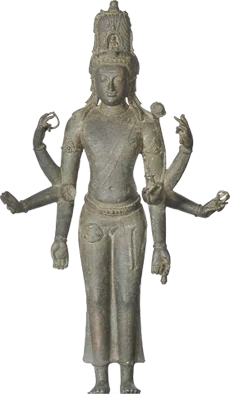
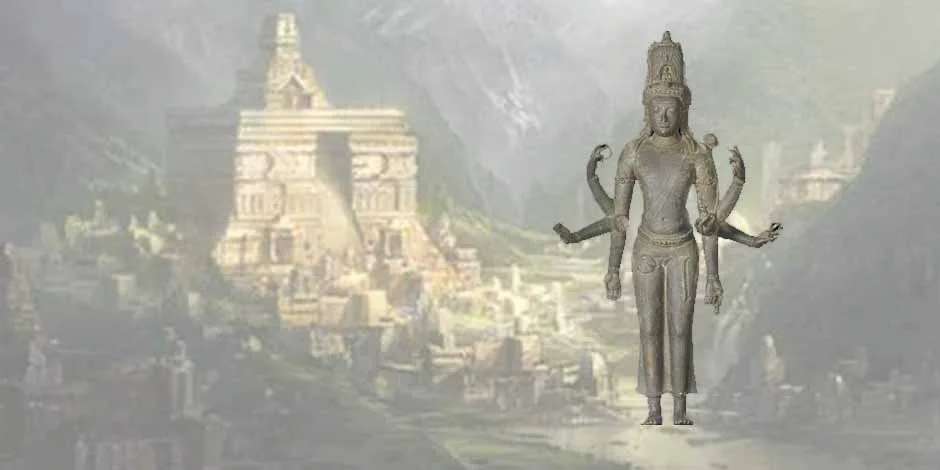
The 63 kg, 93 cm tall bronze statue is an Avalokitesvara, one of the "Bodhisattvas" in Buddhist belief. It was found in 1936 in Bidor, a small town in the state of Perak, Malaysia, at a tin mine owned by Anglo Oriental, the largest British-owned tin company during the British Malaya era. It is made of bronze and has eight arms, though one is broken. According to dating, this statue is estimated to have existed between the 7th and 12th centuries AD during the Hindu-Buddhist civilization era. Recognized as a National Heritage Artifact, the statue is believed to date from the 7th to the 12th century, during the reign of Hindu-Buddhist Malay kings. The prosperity and wealth possessed by the Gangga Negara kingdom allowed it to successfully defend itself against an attack by the Srivijaya kingdom in 850 AD. The Gangga Negara kingdom is said to have been destroyed in the 11th century AD when it was attacked by the Chola dynasty under the leadership of King Rajendra Chola in 1025 AD. This event is also recorded in the story of the Chola kingdom's attack on Srivijaya and the states in the northern Malay Peninsula, particularly the attack on the Kadaram or Kedah kingdom. Many scholars state that this attack included the conquest of the Gangga Negara kingdom. This fact is also agreed upon in local sources, particularly through the records in the Sejarah Melayu. However, there is a slight discrepancy regarding the name of the king who attacked Srivijaya and the Malay kingdoms in the Nusantara, namely Raja Suran. It is not certain whether King Rajendra Chola I and Raja Suran are the same person. Many studies have found that these two leaders were indeed two different individuals. However, what is certain is that the Gangga Negara kingdom, which ruled from the 5th to the 11th century AD, was destroyed by the Chola kingdom in 1025 AD. This effectively refutes the claim that the Chola shaped Malay culture and civilization, as ancient Malay kingdoms were established long before the Chola attacks. Furthermore, Raja Suran or Raja Chulan is not Raja Rajendra Chola, as claimed by some parties. The Chola attack led to the fall of the Srivijaya kingdom of the Sailendra dynasty, and the timing of the attack coincides with the return journey of the famous Buddhist monk Atisa from Sumatra to India in 1025.