The Controversial History of Perak Celebrating Hari Raya Early in 1982
The Controversial History of Perak Celebrating Hari Raya Early in 1982
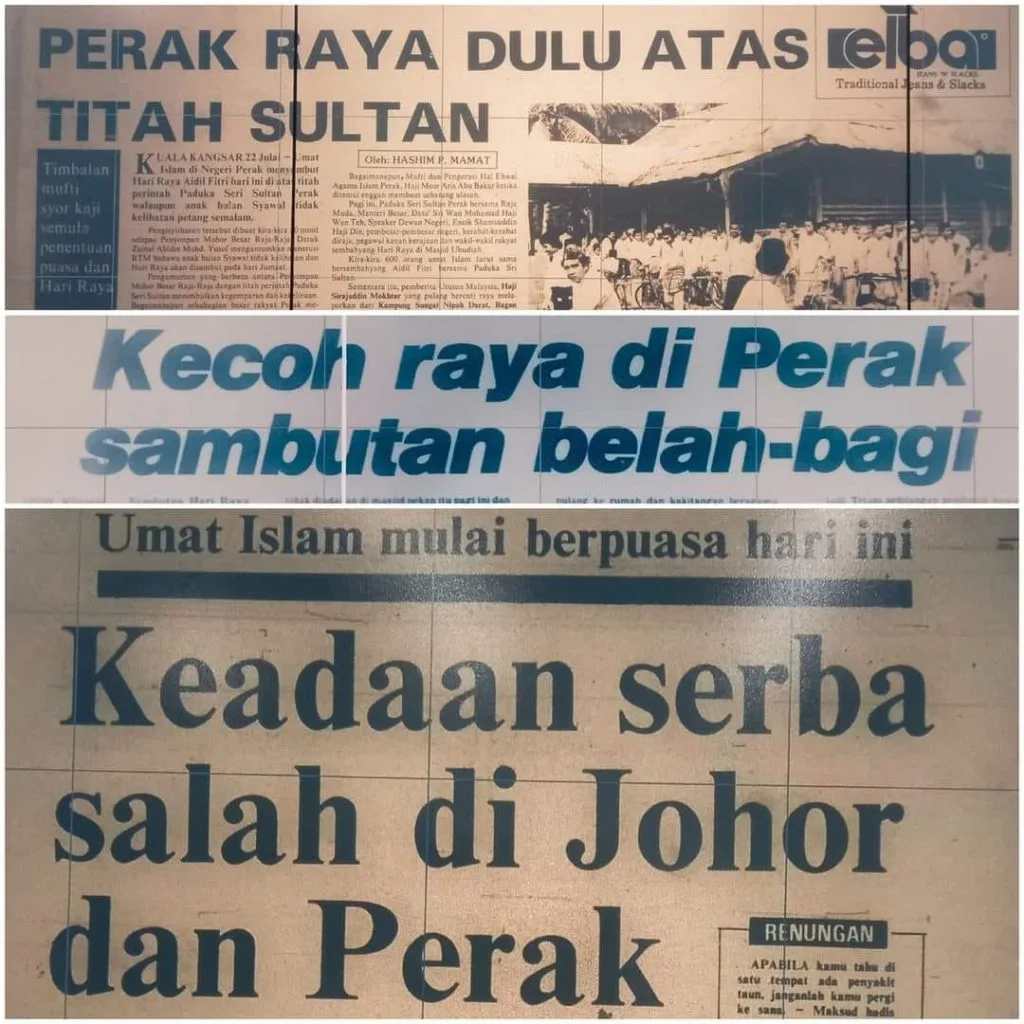
In the annals of Malaysian history, rich with colorful cultures and traditions, there is a unique chapter that remains fresh in many memories: the moment when the state of Perak boldly celebrated Hari Raya Aidilfitri a day earlier than the rest of the country on July 22, 1982.
This event is not merely an ordinary historical record, but an important episode that challenged norms, tested unity, and showcased the strength of the monarchy in Malaysia, particularly in the state of Perak.
What made this event so special? How could a decision made at the Istana Kuala Kangsar shake the entire nation? Why, after more than four decades, is this story still relevant to study and understand? Let us delve deeper into these historic moments.
Royal Power vs. National Uniformity
To fully understand the 1982 controversy, we must delve into Malaysia's unique system for determining Hari Raya dates. Since the pre-independence era, every Malay state has held absolute rights in determining the start of the Islamic month based on the sighting of the new moon (rukyah) within their respective territories.
However, according to Tun Suffian Hashim's memoirs (1976), the situation became complicated after the Second World War when it frequently happened that Kelantan might celebrate Aidilfitri on a Tuesday, while Johor celebrated it on a Wednesday. This discrepancy not only caused confusion but also impacted administrative affairs, especially as Malaysia was moving toward the formation of a nation-state.
The Conference of Rulers later reached a compromise by allowing the Yang di-Pertuan Agong to set the Hari Raya date for the entire country. However, under the Federal Constitution, the absolute rights of the state Sultans in Islamic religious affairs remained preserved. This was the seed that eventually grew into the tree of controversy in 1982.

July 21, 1982, The Night That Changed Everything
Imagine the atmosphere in Tanjung Kepah, Lumut, on the evening of July 21, 1982. Official officers from the Perak Islamic Religious Department were diligently observing the western horizon, hoping to spot the elusive Shawwal new moon. According to official reports, no new moon was sighted, which should have meant that Ramadan would last 30 days and Hari Raya would fall on July 23 (Friday).
However, at that critical moment, unofficial reports emerged from local residents claiming to have seen a "faint light" on the horizon. This report reached Sultan Idris Shah through certain channels. Within a short period, His Majesty held an emergency meeting with the Perak Islamic Religious Council and several prominent state scholars.
According to an anonymous palace source, the discussion was heated with various views presented. Some argued that they should follow the central government's decision, while others insisted that the local residents' reports could not be taken lightly. Finally, at 11 p.m.—while the majority of Perak's citizens were preparing for bed or busy preparing the final suhoor meal—a royal decree was issued: Tomorrow is Hari Raya Aidilfitri for the state of Perak.
Even more astonishingly, this decision was announced only 30 minutes after the Keeper of the Rulers' Seal in Kuala Lumpur had officially declared that Hari Raya would be celebrated on Friday nationwide! The Berita Harian offices in Kuala Lumpur and Penang were flooded with phone calls from Perak residents seeking to confirm the news.
Information Dissemination Operation, Midnight Chaos
What happened after that announcement was a unique episode. Without social media or mobile phones at the time, Perak authorities had to use every creative means to convey this important news:
- Kuala Kangsar Siren - Uniquely, this royal town had a colonial-era siren system usually sounded during iftar. That night, the siren sounded repeatedly as a signal for Raya.
- Police Car Patrols - District police units, the information department, and the military were ordered to enter remote villages with loudspeakers, waking residents with the surprise announcement.
- Telephone Chain - In major towns like Ipoh and Taiping, district officers initiated a "telephone chain" by calling village heads, who were then responsible for informing their neighbors.
- Mosques and Suraus - The bilal of Masjid Ubudiah, Mr. Abdullah Ali, made the announcement twice through the loudspeaker system, followed by other mosques throughout the state.
However, not all news arrived on time. In rural areas like Hulu Perak and Batang Padang, many only learned of the decision after dawn, when Raya preparations should have already been completed.
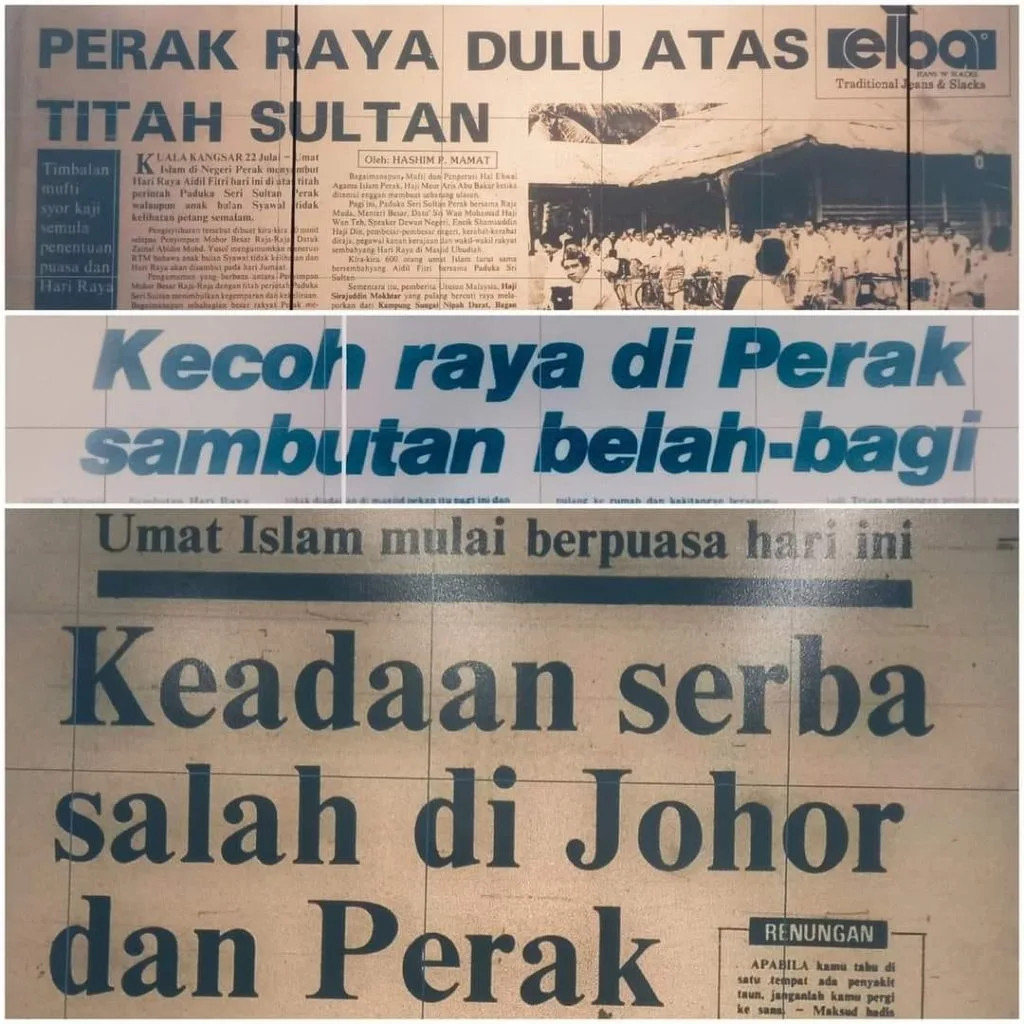
The Most Unusual Hari Raya
July 22, 1982, might have been the strangest Hari Raya in Perak's history. The atmosphere throughout the state was described as "gloomy" and "chaotic" by eyewitnesses:
- In Hutan Melintang, the Jamek Mosque, usually full on the morning of Raya, was only attended by a handful of congregants. Most residents chose to continue fasting because they were unsure about the last-minute decision.
- In Sitiawan, a group of congregants who arrived at the mosque were shocked to find no imam or bilal. They eventually had to drive 15km to the Lumut Mosque to perform the sunnah prayers.
- In Ipoh, hundreds of civil servants arrived at the office as usual, only to find the office doors still locked. Some returned home embarrassed, while others waited in the hope of new instructions.
However, 1,000 people performed prayers at the Perak State Mosque in Ipoh. Their attendance was gradual after receiving the news in the morning. Sultan Idris himself performed prayers at the Ubudiah Mosque along with relatives, state leadership, and 600 other congregants.
More interesting are the personal stories recorded by journalists:
- A family in Kampar was divided when the father wanted to celebrate Raya according to the Sultan's decree, while the mother refused because she followed the decision of her friends who continued fasting.
- In Pengkalan Hulu, there were residents whose houses were located exactly on the state border line. They were confused about whether to celebrate or not because neighbors across the street (in Penang) were still fasting.
- A Raya cookie seller in Kuala Kangsar was reported to have cried because she had prepared hundreds of packs of cookies to sell on July 23, but had to discard them because they would not last.
Two Hari Rayas in One State
Even more unique, not all districts in Perak celebrated Raya on July 22. Some areas, such as around Grik and Lenggong, chose to follow the central decision and celebrated on July 23. This created a situation where some families celebrated on different days despite living in the same state!
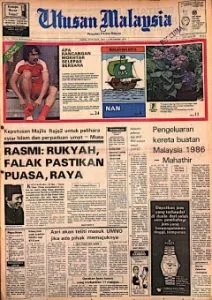
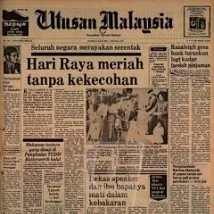
The newspapers Utusan Malaysia and Berita Harian on July 23, 1982, featured contrasting reports:
- Utusan: "Perak Celebrates Alone - Gloomy Celebration Throughout the State"
- Berita Harian: "Confusion in Perak - Some Celebrate, Some Fast"
Interestingly, the Utusan report was written by veteran journalist Hashim P. Mamat, a native of Kuala Kangsar who delved into the real atmosphere by interviewing various levels of society. He also included an exclusive photo of Hutan Melintang residents leaving the mosque after Raya prayers—a photo that serves as important historical evidence today.
Long-term Impact
This 1982 controversy did not end with just the Raya celebration. Sultan Idris Shah later prepared a complete working paper presented at the Conference of Rulers meeting on October 13-14, 1982. This paper was also distributed to the National Fatwa Committee ten days earlier.
Interestingly, no objections or amendments were submitted against the working paper. This was considered an unofficial agreement regarding state rights in religious affairs. The most significant impact appeared the following year (1983) when Perak again made a different decision by setting 1 Ramadan on June 12, compared to the national date of June 13. This time, Johor under Sultan Iskandar also made the same decision.
This 1983 polemic sparked an even fiercer debate about:
- The use of hisab (astronomical calculation) vs. rukyah (sighting)
- The boundaries of power between state and federal governments
- The importance of uniformity vs. respect for local authority
Professor Mohd Khir Taib, a prominent astronomy expert, had to come forward to provide a detailed explanation of the cause of this difference through an official letter to the Director-General of the Islamic Center.
Reflection: The Meaning Behind the Controversy
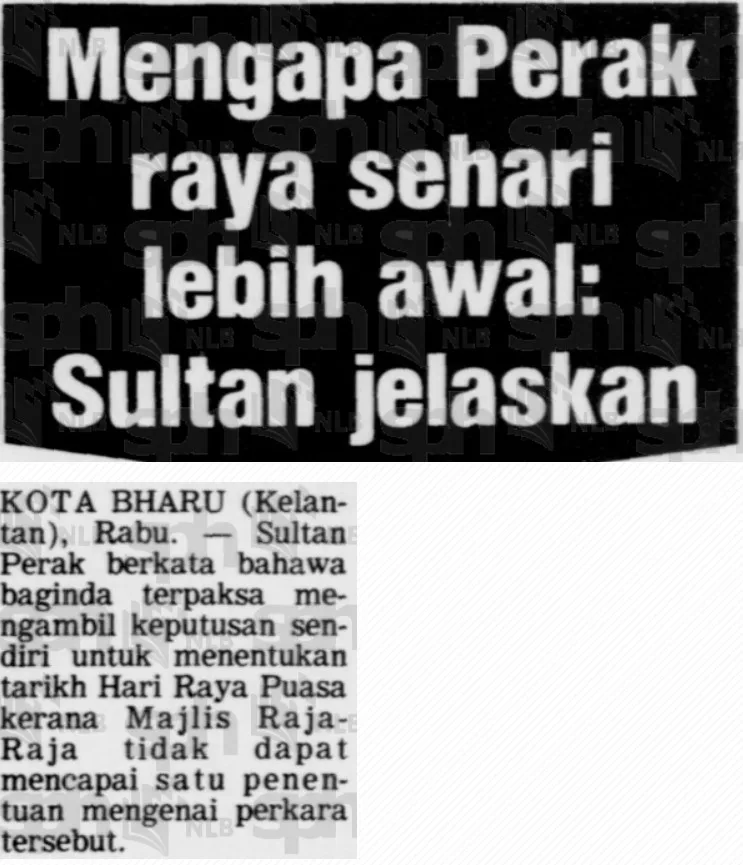
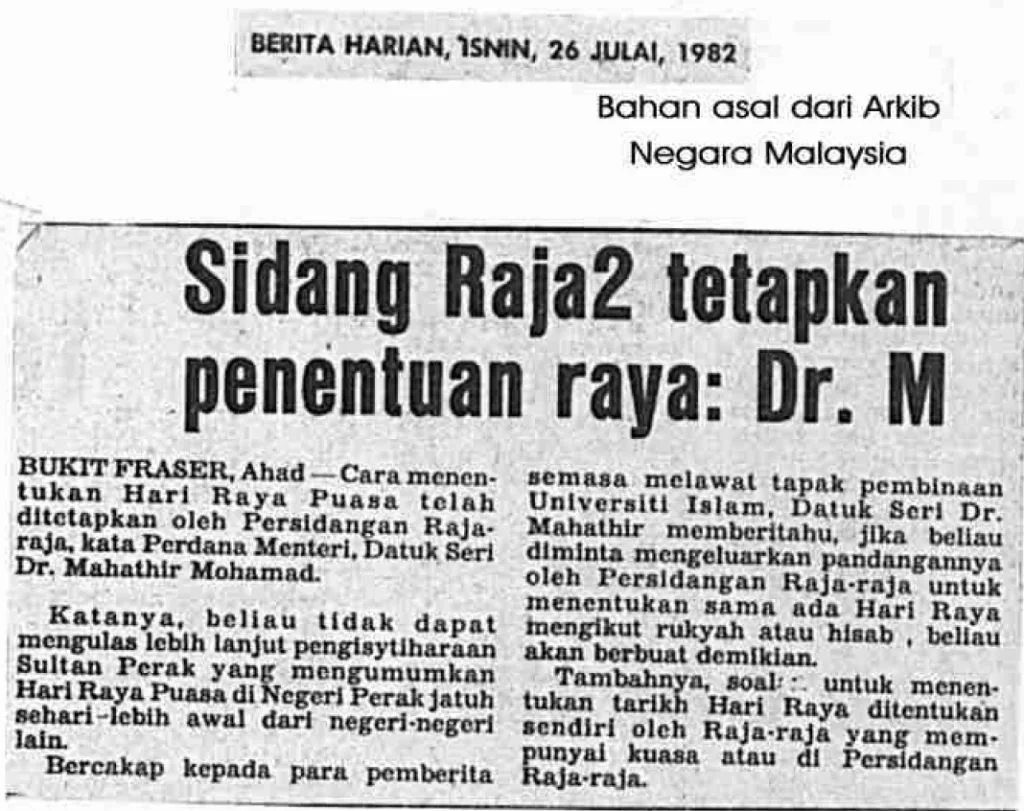
The Sultan of Perak explained to Berita Harian on July 29, 1982, why he acted to announce Hari Raya earlier. In his view, this was a consequence of the Conference of Rulers failing to reach a consensus to set the Hari Raya date, which forced him to make his own decision.
He also recommended that after the event of Perak celebrating Raya a day early, the task of sighting the new moon should be handed over to members of the Royal Malaysian Navy because they are constantly trained and have modern equipment to sight the new moon.
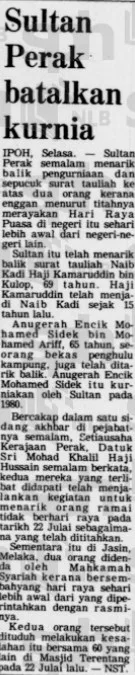
His Majesty also later took action by revoking the credentials he had bestowed upon the Vice Kadi, Haji Kamaruddin bin Kulop, and former village head Mr. Mohamad Sidek. They were found to have carried out activities to not celebrate Hari Raya on July 22 as decreed.
Forty-two years later, this 1982 event leaves us with several important lessons:
- Tension between tradition and modernity - How a state strives to maintain religious identity within a modern national system.
- Dynamics of center-state relations - A perfect case study on federalism in Malaysia.
- Evolution of the Islamic date-setting system - This controversy contributed to the perfection of a more robust date-setting system today.
- Mass psychology - How society faces situations of uncertainty and conflicting authorities.
More interestingly, this event is living proof of the flexibility of the monarchy in Malaysia—where the Sultan is not just a symbol, but has real power that sometimes needs to be used even if it is unpopular.
Epilogue
The 1982 Early Raya controversy may have long passed, but it remains fresh in memory as the moment when Perak dared to be different—a special chapter in the history of religious pluralism in Malaysia.
In 1983, both Perak and Johor set the start of Ramadan and Shawwal a day earlier than other states in Malaysia. This matter caused a major dispute, to the point that the state of Perak threatened to withdraw from the National Council for Islamic Religious Affairs Malaysia.
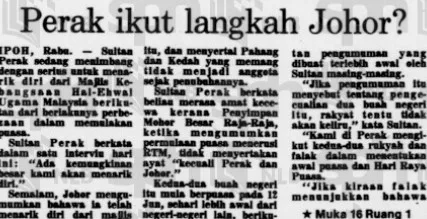
The Sultan of Perak expressed his disappointment because RTM broadcast the announcement of the start of fasting with the phrase "Except for the States of Perak and Johor." Johor had previously withdrawn from the council due to a similar dispute.
However, such matters have never happened again after 1983, with all important Hijri dates standardized throughout Malaysia. Hari Raya Aidilfitri in 1983 was also celebrated simultaneously by all states in Malaysia, despite the friction during the start of Ramadan that year.
This was all thanks to another decision made in the 125th Meeting of the Conference of Rulers on October 13 and 14, 1982, at the Istana Negara, chaired by the Sultan of Kedah, Sultan Abdul Halim Mu'adzam Shah ibni Al-marhum Sultan Badlishah. According to a Bernama interview with the Keeper of the Rulers' Seal, Datuk Seri Syed Danial Syed Ahmad in 2014, the Malay Rulers reached a consensus to allow the Yang di-Pertuan Agong to set the dates for 1 Ramadan and 1 Shawwal, which would be standardized for all of Malaysia.
Then in 1992, Malaysia, Brunei, Indonesia, and Singapore set the start of the Hijri month using Imkanur Rukyah, which is Rukyah and Hisab. However, in 2022, the country celebrated Raya a day earlier than the date set in the calendar once again because the new moon had been sighted.
References:
- Berita Harian, July 26, 1982
- Berita Harian, July 29, 1982
- Berita Harian, September 1, 1982