The 1979 Kroh Communist Terrorist Ambush Tragedy
During the Emergency era, the northern region of Perak, particularly around Grik and Pengkalan Hulu, was a hotspot for communist terrorist activity, focusing on government sabotage and military ambushes.
This was due to the dense forests and hilly terrain, which facilitated guerrilla warfare. In this article, orangperak.com explores a tragic event that serves as evidence of communist atrocities against the people of Malaysia: the ambush in Kroh in 1979. This bloody incident occurred at 10:45 AM on July 20, 1979, when a convoy transporting patients from Baling to Kroh (now Pengkalan Hulu) was suddenly ambushed by approximately 20 communist terrorists while passing through Batu 54, Jalan Kroh-Baling.
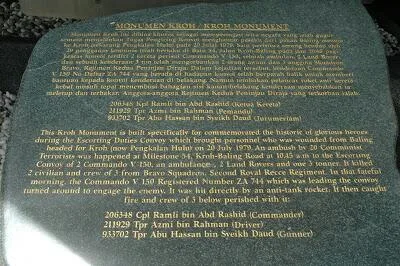
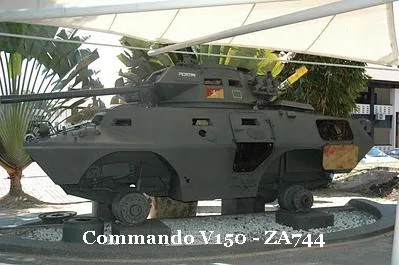
The convoy consisted of an ambulance, a 3-ton military truck, and two military Land Rovers. The group had been in Baling town since 7:00 AM, waiting for a scout team to escort them with armored vehicles for added security. The convoy departed Baling at 9:00 AM, escorted by two V-150 Commando armored vehicles from the "Bravo" Squadron, 2nd Reconnaissance Regiment. The convoy was led by a V-150 armored car (number ZA744), followed by the ambulance, two Land Rovers, a 3-ton truck, and another V-150 armored car at the rear. As the convoy reached a bend before a military-controlled roadblock, they were suddenly ambushed by communist terrorists, who targeted the ambulance first.
Due to the narrow road preventing the V-150 armored car from turning, the driver had to reverse while the gunner rotated the turret toward the terrorists' position. However, before the soldiers could return fire, the communist terrorists struck the armored car with an anti-tank weapon, causing it to burst into flames and killing all three crew members almost instantly. Soldiers from the other vehicles immediately exited to find cover. Communist gunfire also left several personnel in the Land Rovers injured. The sounds of gunfire and explosions were heard by soldiers at the Kroh Camp, including an Alouette III helicopter pilot.
This helicopter was equipped with a 20mm cannon and served as a "gunship." These armed Alouette helicopters also acted as Forward Air Controllers (FAC), guiding Tebuan jets for ground strikes during Royal Malaysian Air Force (RMAF) operations against communist positions. The Alouette helicopter from No. 3 Squadron, RMAF Butterworth, had taken off that morning to escort a Nuri helicopter in the Operation Selamat Sawadee area, Kroh. The pilot and an artillery officer reported seeing smoke rising from the ambush site. The pilot contacted RMAF headquarters for permission to assist the convoy but did not receive an immediate response. Consequently, the pilot decided to fly to the ambush location. Upon arrival, he ordered the gunner to fire at the trees believed to be the terrorists' hiding spots. However, the Alouette was only using 20mm "ball" ammunition instead of "HE" (high explosive) rounds. At the time, the RMAF had run out of 20mm HE stock and was waiting for a C-130 Hercules to fly to Portugal to replenish it. The ball ammunition provided significantly less impact than the 20mm HE rounds.
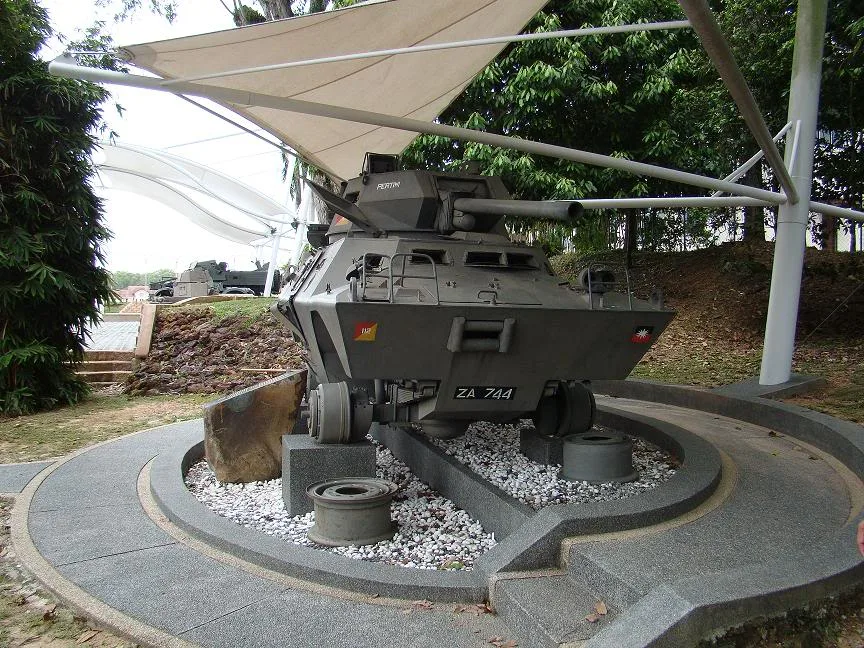
Regardless, the Alouette's presence and suppressive fire forced the communist terrorists to retreat. The attack claimed the lives of 3 soldiers and 2 civilians. The fallen soldiers were Corporal Ramli bin Abdul Rashid (armored car commander), Trooper Azmi bin Rahman (armored car driver), and Trooper Abu Hassan bin Syeikh Daud (armored car gunner). The pilot's swift action in saving the lives of the remaining personnel was recognized when No. 3 Squadron received a letter of appreciation from Major General Dato’ Jamil Ahmad. It is highly likely that there would have been more casualties had the Alouette helicopter not provided immediate assistance. The Army Museum in Port Dickson has erected a monument to commemorate the sacrifices made by the soldiers in this event, and the armored car hit by the RPG has been preserved as a memorial.