History of the Selangor-Perak War of 1804: When Brothers Became Enemies for Power and Tin
History of the Selangor-Perak War of 1804: When Brothers Became Enemies for Power and Tin

At the beginning of the 19th century, the Malay Peninsula was at a historical crossroads. The power of the Dutch East India Company (VOC) was fading, the British East India Company (EIC) began to establish its foothold in Penang, while the Siamese hegemony in the north was a constant threat. It was in this uncertain geopolitical landscape that a bloody conflict erupted between two neighboring states that were once brothers: Selangor and Perak.
The invasion of Perak by Selangor in 1804, under the leadership of the ambitious Sultan Ibrahim Shah, was not merely a typical border dispute. It was a manifestation of a clash between an aggressive new power and an old, wealthy kingdom struggling with internal weaknesses.
Ironically, the Sultanate of Selangor itself was born from the recognition and sovereignty granted by the Sultanate of Perak. This article will discuss in depth how this bond of friendship turned into hostility, tracing the causes of the conflict, key events, and the legacy it left behind.

Early Ties: From Recognition to Alliance
The relationship between Selangor and Perak was originally very close. The Sultanate of Selangor, founded by Bugis nobles in the mid-18th century, required validation from an established Malay kingdom to gain legitimacy.
The founder of the Selangor Sultanate, Raja Lumu ibni Daeng Chelak, was installed by the 16th Sultan of Perak, Sultan Mahmud Shah, in 1766 with the title Sultan Salehuddin Shah.
The installation ceremony in Perak birthed a deep bond of friendship. It is said that both states swore to be "like one blanket for the two of them," and pledged that "the night in Perak is the night in Selangor, the pain in Perak is the pain in Selangor." This alliance was not just empty words; Selangor once sent military aid to help Perak repel a Siamese attack.
However, behind this close relationship, there existed latent economic competition, especially in the Bernam River Basin, which was rich in tin. The concept of borders at that time was not as fixed as it is today. It was more of a zone of influence determined by the "ruler's jurisdiction." Control over an area often changed hands depending on the strength of the reigning sultan, creating a state of "constant competition" that was just waiting to explode.
Cracks Waiting to Break: Causes of the War
The invasion in 1804 was triggered by a combination of three main factors: official justification, strategic opportunity, and hidden motives.
- Casus Belli (Reason for War): The Broken Treaty
The official justification used by Sultan Ibrahim was the claim that Perak had violated their friendship treaty. Around 1800, while Sultan Ibrahim was in Lingga, a delegation from Perak reportedly offered the Perak throne to Sultan Mahmud of the Johor-Riau-Lingga empire.
This action was considered a major betrayal, giving Sultan Ibrahim a legitimate reason under custom to launch a "punitive action." However, many historians believe this was merely a pretext to justify greater ambitions. - Strategic Opportunity: Perak's Internal Weakness
The most important factor that made Perak an easy target was its internal political instability. Toward the end of the reign of Sultan Ahmaddin Shah (1786–1806), Perak was already weak, squeezed between the Siamese threat in the north and Selangor's ambitions in the south.
The situation became much worse when Sultan Ahmaddin passed away in 1806. His death triggered a succession crisis so severe that the late Sultan's body could not be buried for three months. The designated heir, Raja Muda Mahmud, refused to be installed, leaving Perak divided into two competing camps and completely paralyzed. This crisis was a "golden opportunity" for Sultan Ibrahim to press his advantage. - Hidden Motives: Sultan Ibrahim's Ambition for Power and Economy
Sultan Ibrahim Shah was a dynamic, aggressive, and visionary ruler. Having recaptured Kuala Selangor from the Dutch in 1785, he had ambitions to make Selangor the dominant power on the west coast. To him, war was a "legitimate and absolute method to control" a kingdom.
Behind these political ambitions lay a very strong economic pull. Perak was the largest tin producer in the region, and the Industrial Revolution in Europe had skyrocketed the demand for this commodity. Controlling Perak meant controlling a lucrative source of income to fund his military and consolidate power.
Invasion and Conquest of Perak (1804-1806)
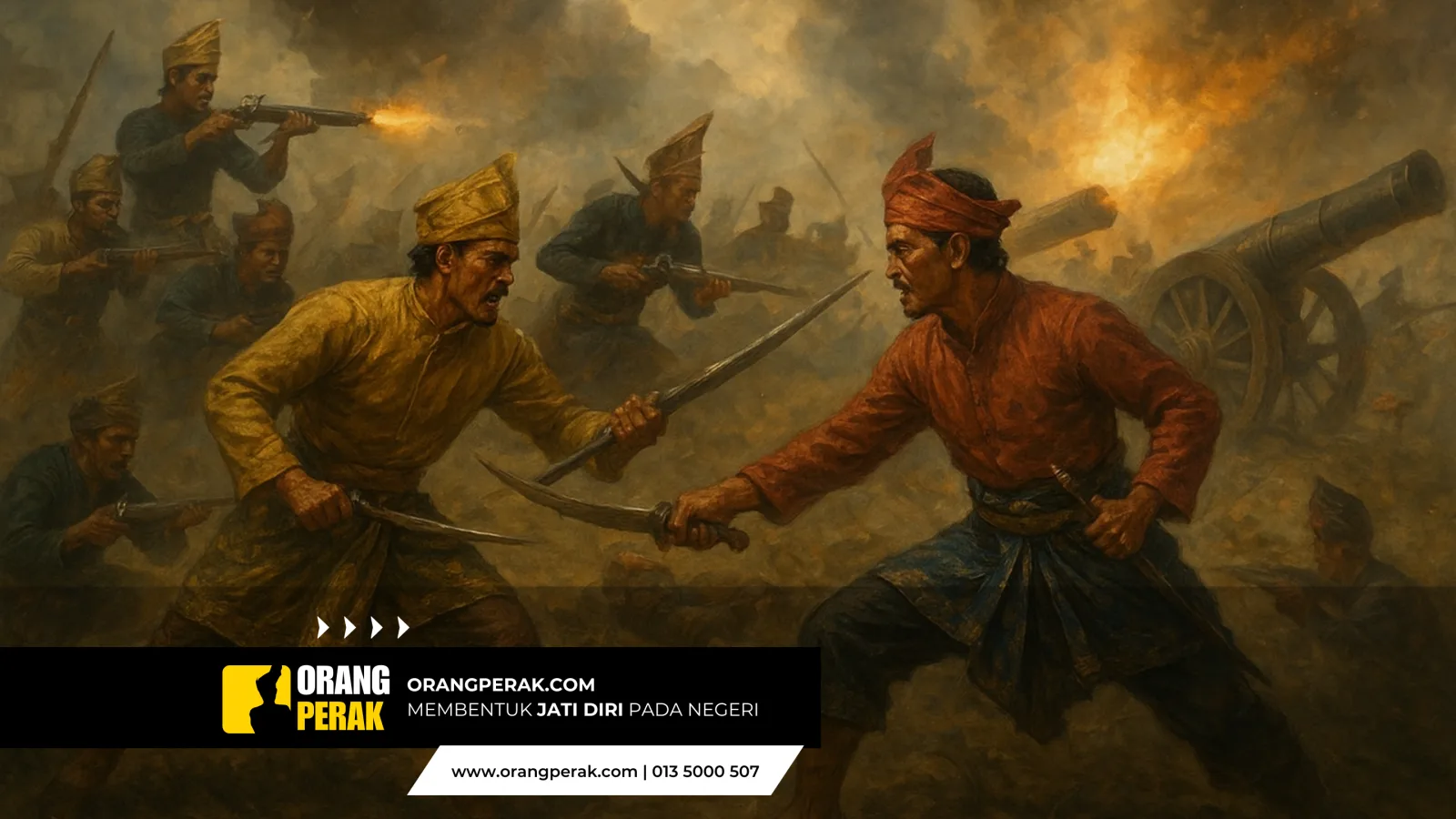
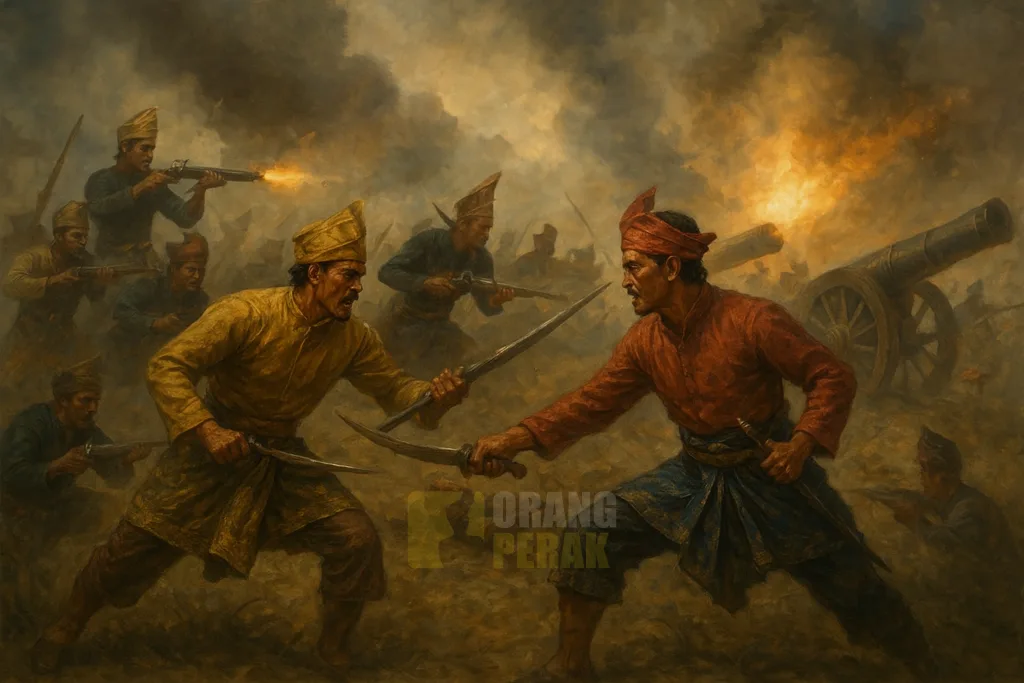
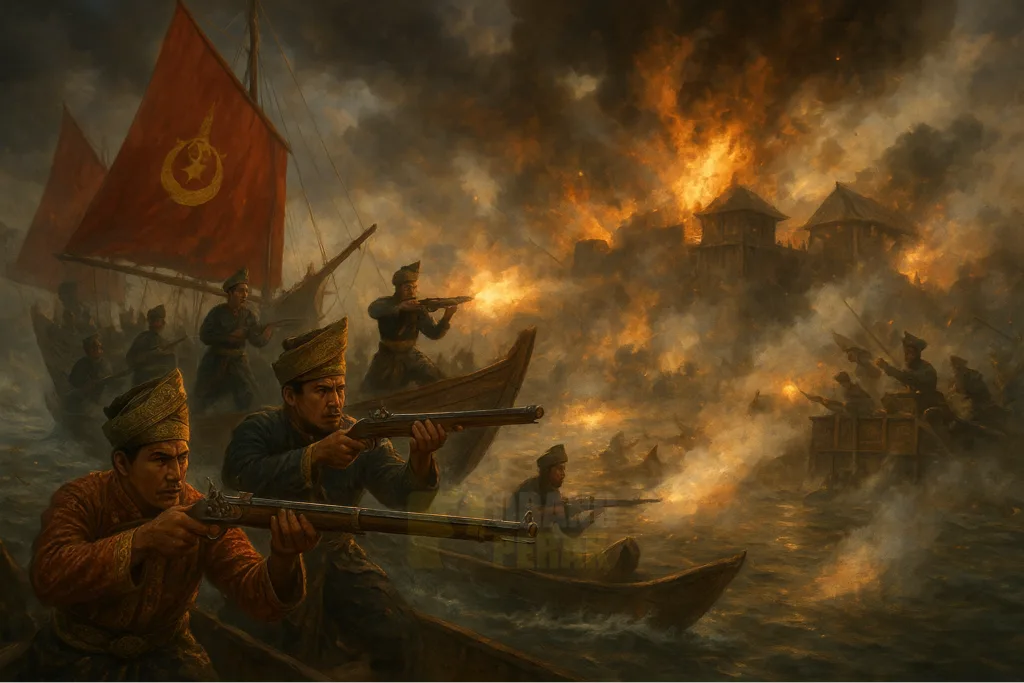
In 1804, the Selangor war fleet, equipped with modern firearms such as muskets and portable cannons, attacked Perak. Their strategy was a rapid assault to capture defensive forts along the Perak River.
Although Perak tried to defend itself by closing the river mouth, their defenses were easily breached by Bugis war tactics. Selangor warriors rowed quickly to crash through Perak's defenses and only fired at close range, causing panic and massive destruction. One by one, Perak's forts fell. Facing defeat, Sultan Ahmaddin Shah and his chiefs were forced to retreat upriver to Kuala Pelus.
By 1805, the entire Lower Perak region was effectively under Selangor's rule. Confidently, Sultan Ibrahim sent a letter to the British in Penang, declaring that Perak was his, captured "by force of powder and ball." This declaration shows that conquest through war was considered a legitimate right in the regional political system at that time.
Era of Conquest and Desperate Diplomacy
After the military victory, Selangor did not, however, govern Perak directly. Instead, Sultan Ibrahim used his position to make a series of territorial and economic demands for nearly two decades. His initial demands covered most of Perak's territory, from Kuala Perak to Kuala Plus. Perak rejected these demands, and Selangor attacked again but failed to capture Perak's new defensive fort at Kota Lumut.
Sultan Ibrahim then stationed his chief, Raja Hassan, to govern the disputed area at Kuala Bidor as a form of de facto assertion of power. For Perak, this era was a very challenging period. Under the reign of Sultan Abdul Malik Mansur Shah (1806–1825), Perak was squeezed from all directions.
In an extraordinary event in 1822, Perak, which was being attacked by Kedah (on Siamese orders), was forced to ask for help from its enemy, Selangor. Sultan Ibrahim agreed, but on the condition that Perak acknowledge Selangor's sovereignty over it. This shows how desperate Perak was and the cunning of its diplomacy in playing regional powers against each other to survive.

British Intervention and the Anderson Treaty of 1825
This prolonged conflict was finally ended not by the victory of either side, but by British intervention. For the British in Penang, the chaos on the west coast disrupted the tin trade, and they feared that Perak's weakness would open the door to Siamese expansion.
In 1825, the Governor of Penang sent an officer named John Anderson to act as a mediator. As a result, on August 20, 1825, a peace treaty was signed between Selangor and the British, followed by a similar treaty with Perak on September 6, 1825.
The main terms of the Anderson Treaty of 1825 were:
- Fixed Border: The Bernam River was established as the fixed and final border between Selangor and Perak.
- No Encroachment: Sultan Ibrahim promised not to attack or interfere in Perak's affairs again.
- Withdrawal of Representative: Selangor's representative, Raja Hassan, would be withdrawn from Kuala Bidor.
This treaty officially ended the hostilities and restored Perak's sovereignty.
The Legacy of a War
The Selangor-Perak conflict of 1804–1825 was a significant turning point in the history of the Peninsula. It closed the final chapter of the autonomous pre-colonial Malay political era and opened a new page where the British began to act as the regional "referee." For the relationship between the two states, the treaty restored peace, but the power dynamics had changed.
Perak survived not because of its own strength, while Selangor's grand ambition to become a hegemonic power was thwarted by colonial power. The greatest legacy of this war was the acceleration of the rise of British hegemony in the Malay region. For the first time, the British succeeded in using diplomacy to force a state that had won the war (Selangor) to relinquish the fruits of its conquest.
This created a precedent that paved the way for deeper intervention in the following decades, culminating in the Pangkor Treaty of 1874. The war between these two brothers, driven by power and tin, ultimately became a bitter lesson on how internal division can open the door to foreign domination.
References:
- Ahmad Farhan bin Abdullah@Zakaria. (2016). Political Relations Between Selangor and Perak, 1804-1825. Jurnal MANU, 23, 67-89.
- Andaya, B. W. (2018). The Perak Sultanate: Transitioning into the 21st Century. ISEAS-Yusof Ishak Institute.
- Arifin, A. (2012). Perak Disturbances 1871-75: British Colonialism, The Chinese Secret Societies and The Malay Rulers. Jebat: Malaysian Journal of History, Politics and Strategic Studies, 39(1), 50-69.
- Gullick, J. M. (2004). A History of Selangor (1766-1939). MBRAS Monograph No. 28. The Malaysian Branch of the Royal Asiatic Society.
- Ismail, M. Z., & Ahmad, A. (2022). The Bernam River in the Perak and Selangor Border Conflict in the 19th Century. Jurnal Munsyi, 10, 50-65.
- SembangKuala. (2009, December 27). 18th Sultan of Perak: Sultan Ahmaddin Shah (1786-1806). SembangKuala: A Kuala Kangsar Community Blog.
- SembangKuala. (2010, January 5). 19th Sultan of Perak: Sultan Abdul Malik Mansur ibni Almarhum Sultan Ahmaddin Shah (1806-1825). SembangKuala: A Kuala Kangsar Community Blog.
- Wangsa Mahkota Selangor. (2012, April 9). Selangor-British Peace and Friendship Treaty 1825.
- Winstedt, R. O., & Wilkinson, R. J. (1934). A History of Perak. Journal of the Malayan Branch of the Royal Asiatic Society, 12(1), 1-180.