History and Origins of the Name Sungkai
According to stories from the elders, the original name for Sungkai was Kampung Kelompong. There are many versions regarding the origin of the name Sungkai. Historically, the name Sungkai was taken from a type of wild tree that grew in the village area and around Sungai Sungkai, known as the Sesungkai Tree. Physically, the core of this tree's trunk is soft like a cassava plant, and its leaves resemble those of the noni (mengkudu) tree.
In addition, the elders of the past loved to use the trunks of the Sesungkai tree to make 'jambo' poles (small huts usually built in durian orchards or farms) because the poles were long-lasting. Kampung Kelompong is one of the old villages found in Sungkai, alongside Kampung Tiang Bertarah, Kampung Changkat Sulaiman, Kampung Perlok, Kampung Buluh Telor, and others. This tree, which was found in abundance, is called the Sesungkai Tree. Because its trunk is straight, the wood was often used to reinforce riverbanks to prevent collapse, allowing the river water to flow continuously. Another version states that the name Sungkai might have originated from the word 'Sungkai', which means 'breaking fast' (iftar) in a language spoken by tribes from Sumatra. It is said that they arrived in the village during the fasting month while intending to break their fast. The arrival of people from Sumatra in the mid-century was driven by the harshness of Dutch rule. There are also those who say that the Sungkai area was opened by Tok Bikam, who came from Kampar, Sumatra. The arrival of these Sumatrans was via rivers that emptied into Teluk Mak Intan. The voyage from
Teluk Mak Intan
to Kampung Tiang Bertarah using a 'Ketiap' boat took nearly 3 days. Connections between the island of Sumatra and Sungkai, as well as other places in this state, were established through trade. Goods from the island, especially from Sumatra, included tobacco, coffee, indigo, and salted fish (ikan peda), which were exchanged for local forest products such as rattan, resin, thatch, gambier, and so on. Later, the arrival of the Chinese and Indians made Sungkai a pluralistic settlement. A final version regarding the origin of the name Sungkai is that it comes from a Chinese word meaning 'chicken wood'. A Chinese merchant who came to buy chickens in this area carried the chickens using a pole. 'Sung' in Chinese means wood, and 'Kai' means chicken.
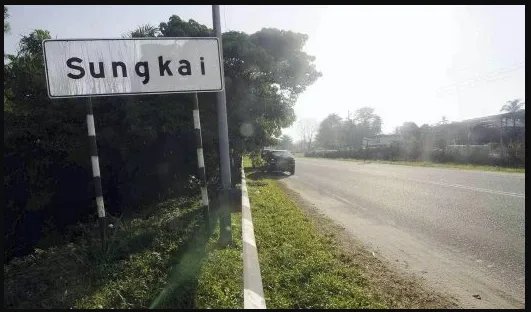
Among the important historical events that occurred here was the opening of new villages for the Chinese community during the Emergency era. The Indian community was placed in rubber plantations in the early 20th century. Villages in the Sungkai area such as Kampung Perlok, Menderang, Changkat Sulaiman, and Kampung Buluh Telur have their own unique stories. Kampung Perlok is said to come from the word 'golok emas' (a word from the Orang Asli). Kampung Buluh Telur got its name from a type of bamboo. Kampung Tiang Bertarah is famous for the story of an asam gelugor tree that was hewn to make house pillars, only to suddenly disappear and become buried. Supposedly, it has a connection with the Sultan of Perak. Kampung Changkat Sulaiman was named after Datok Sulaiman, who came to open the village. To this day, his grave is still there. Sungkai has its own history because, according to the elders, the Sultan of Perak was once said to have a connection with
Puteri Buih
because the Sultan of Perak married his child to
Puteri Buih
who was said to come from the 'bunian' (supernatural) realm. Therefore, as a sign of respect for
Puteri Buih
an agreement was made between the side of
Panglima Hitam
and the Sultan's side, and two conditions were set: 7 generations of the descendants of
Puteri Buih
are forbidden from stepping on Sungkai soil without royal customs involving yellow cloth, and they cannot drink water originating from the rivers in the Sungkai Mukim. If this is violated, a disaster or catastrophe will befall the land of Sungkai. The extent of the truth of this is unknown, until an event 15 years ago when the Sultan of Perak, Sultan Azlan Shah, came to Sungkai to officiate a mosque in one of the villages in Sungkai. After His Majesty arrived in Sungkai and stepped on the soil, a very strong storm and wind suddenly occurred in Sungkai, causing 20 houses in several villages to suffer serious damage. Furthermore, an incident that further reinforced the belief in the curse of
Puteri Buih
on the Perak royal lineage occurred once more when the Raja Muda of Perak, Raja Dr. Nazrin Shah (now Sultan), came to break fast at the Sungkai Mosque on August 12, 2012. It is said that at that time, His Majesty brought his own water from his palace to be used for ablution. As fate would have it, no more than ten minutes after His Majesty departed from Sungkai, the land of Sungkai was once again hit by a very strong storm, causing the Sungkai Secondary School and several houses around Sungkai to suffer quite severe damage. This is acknowledged by all the older generations in Sungkai, and this story has become ingrained in the residents of Sungkai whenever the history of Sungkai is brought up. However, only Allah knows the truth of this story. Sungkai town began to be connected by rail in 1894. It connected Bidor in the north and Slim River in the south. The original site of the railway station is where the current bus station is located. Due to the fear of the train sliding because it was on high ground, the station was moved about a mile from Sungkai town. The main modes of transport back then were rickshaws and horse carriages. The arrival of the Indians and Sikhs changed the transportation methods to bullock carts, alongside the Chinese who were still pulling rickshaws. In terms of the economy in this area, the Malays engaged in agricultural activities, the Chinese became merchants and laborers in mines, and the Indians worked in estates. The Chinese community, who succeeded in producing 'taukes' (bosses) in mining and business, built the Khai Meng Chinese School in 1923. The National School established in 1900 was the earliest school in the Batang Padang area, and another school was built in the East (Temoh). Students from as far as Tapah came to Sungkai by train without being charged any fare. Today, that school has become an Arabic school in Pekan Lama. Sungkai town continues to develop with the passage of time. The history of Sungkai town is incomplete without including the developments after the Second World War. One of the notable ones is the opening of the Sungai Klah area in 1960, which began to be occupied 4 years later. The name Sungai Klah appeared after the 'kelah' fish. Today, the Sungkai area is advanced with palm oil and rubber industries, as well as tourism activities with the existence of the Sungai Klah hot springs. The opening of Felda Trolak and Besout has made the Sungkai area one of the main producers of rubber and palm oil in the state of Perak today.