Governance Existing Before the Perak Sultanate
According to records from a book written by Abdul Halim Nasir, currently held at the National Museum, before Sultan Muzaffar Shah I ruled the State of Perak in 1525, there were already local chieftains who governed and held authority in every district throughout the state.
One of those districts was Dinding, which was a very powerful Malay Kingdom within the State of Perak at the time, known as the Beruas Malay Kingdom. Its administrative center was at Kota Kulit Kerang (the area is now known as Kampung Kota, located about two miles from Pekan Beruas).
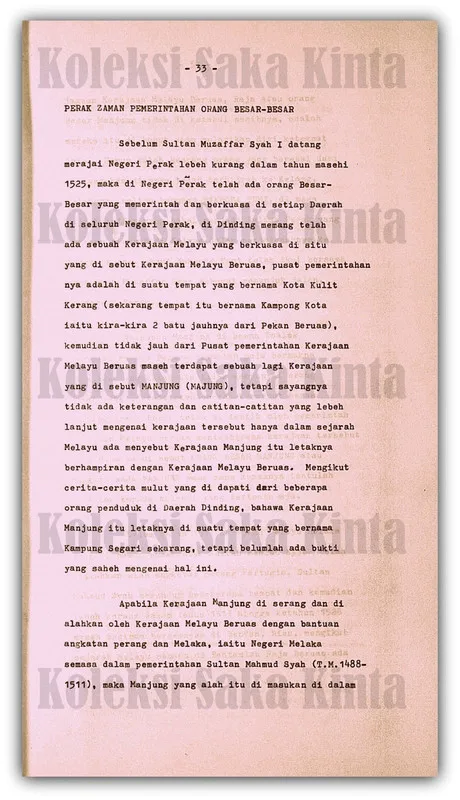
Another district was known as the Manjung Kingdom, with its administrative center located in what is now Kampung Segari. When the Manjung Kingdom was attacked and defeated by the Beruas Malay Kingdom, Manjung was placed under the guardianship of the Beruas Malay Kingdom. A ship captain (Nakhoda) of Manjung descent, who had migrated to Klang, once accompanied Raja Muzaffar Shah—who would later become the Sultan of Perak—as a guide. This captain was known as Nakhoda Tumi.
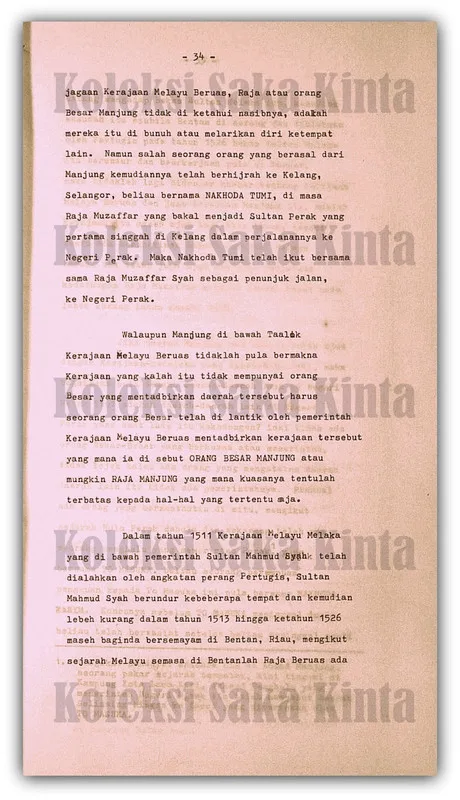
Although Manjung was under the rule of the Beruas Malay Kingdom, it did not mean that the defeated kingdom's leadership was replaced or that officials appointed by Beruas were installed. The original ruler, the Raja of Manjung, remained in power, albeit with specific and limited authority. If the districts of Manjung, Dinding, and Beruas already existed as kingdoms within the State of Perak, what about the other districts in the state? It would be illogical for historians or other individuals to claim there was no governance in the other regions, given that the State of Perak was vast.
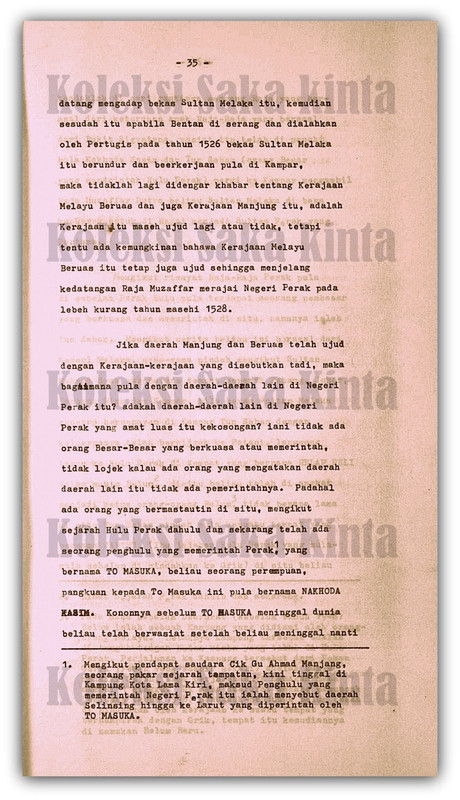
In the district from Selinsing to Larut, there was once a female chieftain named Toh Masuka. Before she passed away, she left a will requesting that her successor be a Raja descended from the royal lineage of Bukit Si Guntang.
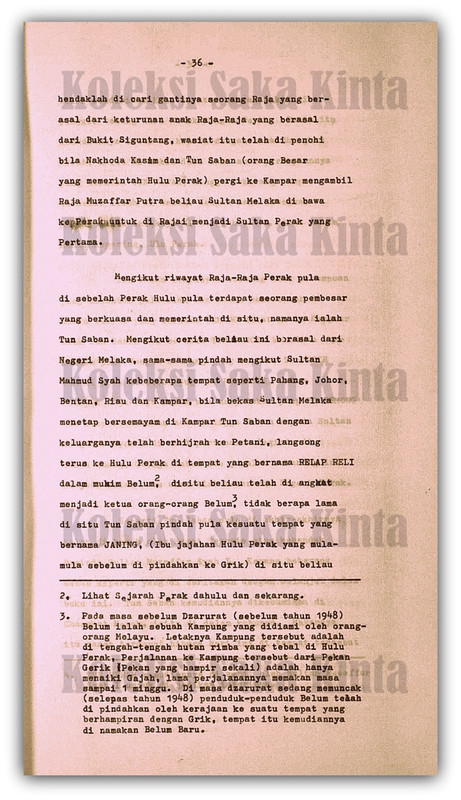
In Hulu Perak, at a place called Relap Reli within the mukim of Belum and Janing (the original administrative center of Hulu Perak before it was moved to Grik), a fortress was built on a hill on the left bank of the Perak River. Known as Changkat Merah, it was located deep in the jungle within the Kenering mukim, where a man named Tun Saban was appointed as the ruler.
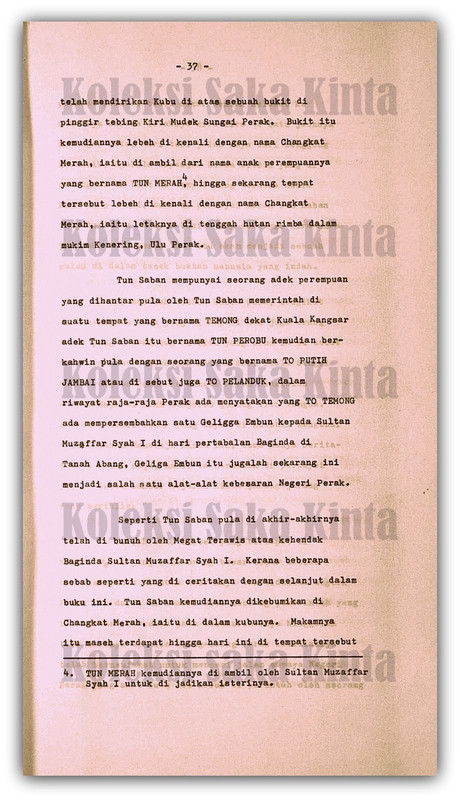
In a place called Temong near Kuala Kangsar, there was also a ruler sent by Tun Saban to govern.
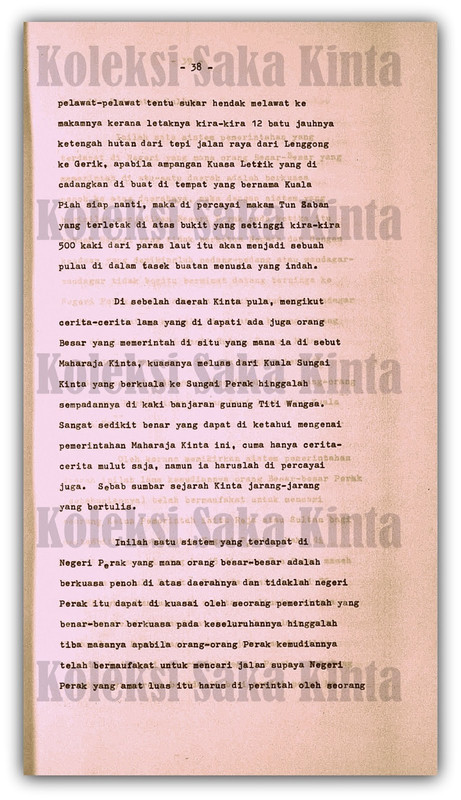
In the Kinta district, the ruler in power was titled Maharaja Kinta or Maharaja Genta. His authority extended from the mouth of the Kinta River where it meets the Perak River, all the way to the Titiwangsa Mountain Range. Pengkalan Pegoh, Kampung Kepayang, Sungai Raia, Ampang, Tambun, Ipoh, and Tg. Rambutan were among the centers of the thriving tin mining industry managed by one of the Perak dignitaries of Maharaja Kinta descent, Tok Sedewa Raja Abdul Wahab. It is said that many of his descendants can still be found in Buntong, Pengkalan, Simpang Pulai, and Tanjung Rambutan.
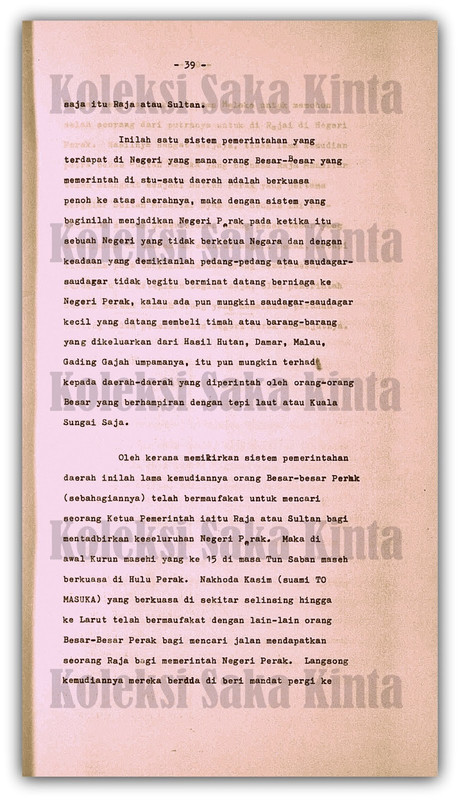
This was a system of governance that existed in the State of Perak, where local chieftains ruled their respective districts with full authority over their own territories.
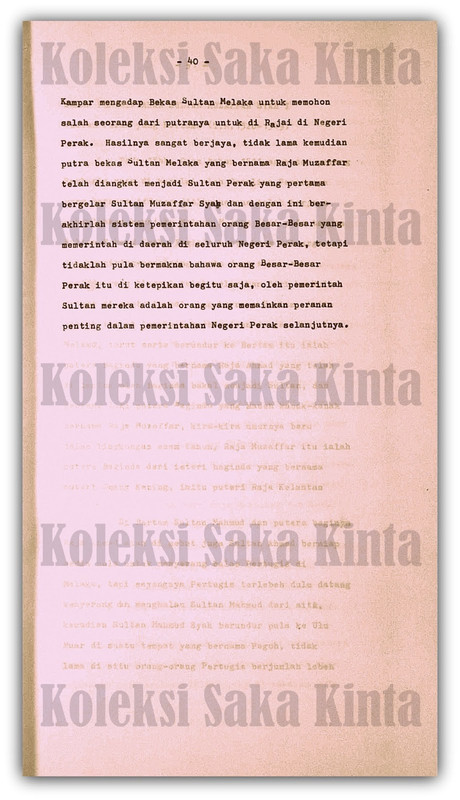
After Sultan Muzaffar Shah was installed as the first Sultan of Perak, the system of local chieftains governing their own districts gradually came to an end.
Do not force a bird to run, if it prefers to fly, If you have the spirit to seek, do not let doubt or worry pass you by.
Ground rice travels upstream, cooked with glutinous rice, coconut milk, and durian, Few people study the past, yet many claim to know it later on.
Bukit Jertih is filled with bamboo, where the king goes to hunt, May the forty angels protect us, if you do not know, do not be ashamed to ask.
The people downstream beat the nobat, struck with chestnut wood, Work hard before you succeed, do not just spend your time daydreaming.
-tokchangkatlanggor-